Your Guide to 347 Stainless Steel Bar: What You Need to Know
347 Stainless Steel Bar: 3 Vital Advantages
Last updated on March 19th, 2026 at 12:11 pm
347 stainless steel bar is a niobium-stabilized austenitic stainless steel for high-temperature applications where grades like 304 are unsuitable. It’s critical to understand 347’s properties when evaluating materials for equipment operating between 800-1500 F or those needing superior post-weld corrosion resistance.
Key Properties of 347 Stainless Steel Bar:
- Niobium Stabilization – Prevents intergranular corrosion after high-temperature exposure (sensitization)
- Temperature Range – Excels from cryogenic temperatures up to 1500 F (816 C)
- Mechanical Strength – Minimum tensile strength of 75 ksi (515 MPa), yield strength of 30 ksi (205 MPa)
- Corrosion Resistance – Similar to 304 in general environments, superior in chromium carbide precipitation range
- Weldability – Excellent for heavy sections without requiring post-weld annealing
- Common Forms – Available as round bar, square bar, flat bar in various sizes
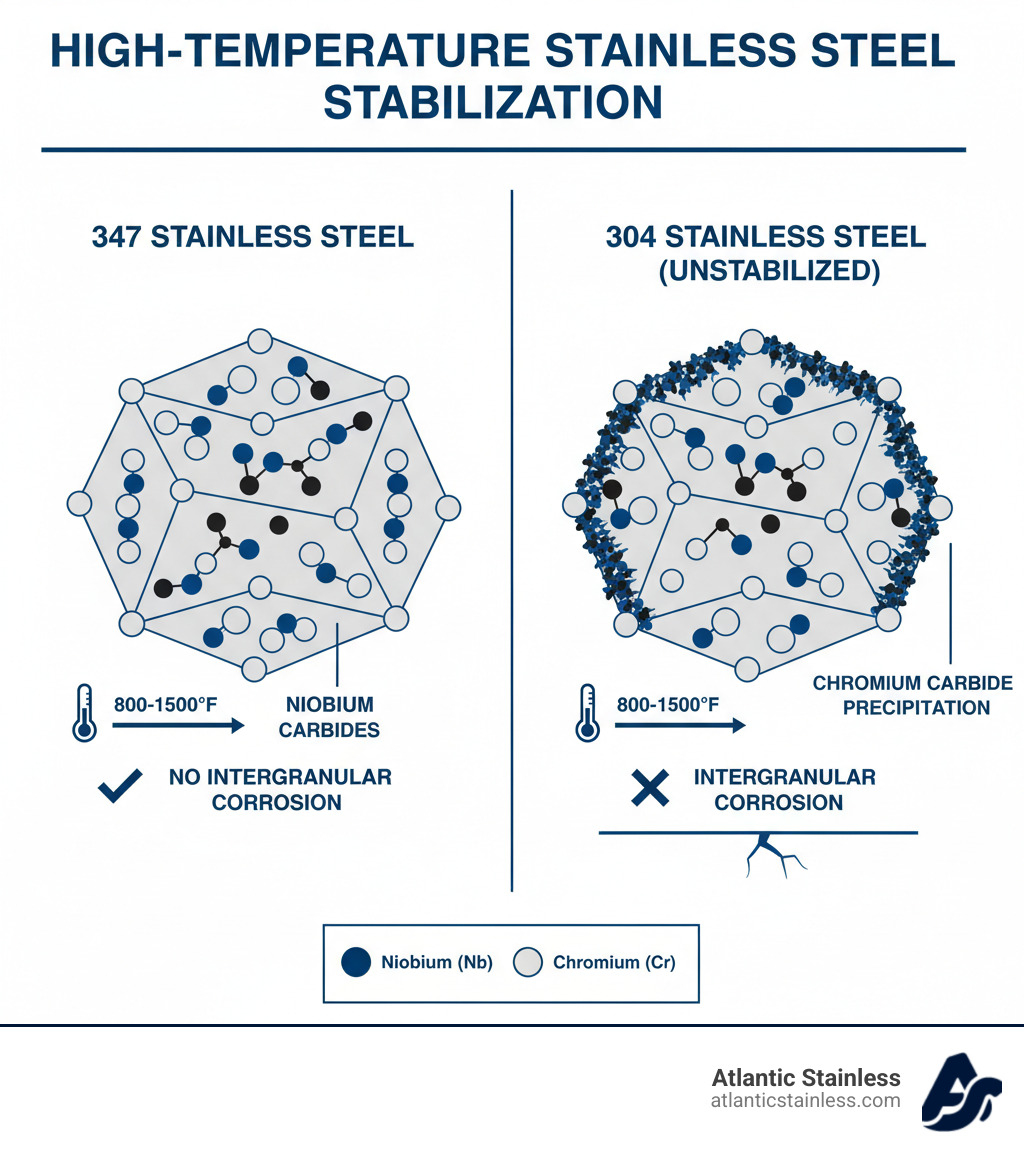
Standard 304 stainless steel, when exposed to 800-1500 F, experiences “sensitization”—chromium carbides form at grain boundaries, making it vulnerable to intergranular corrosion. The niobium (columbium) in 347 solves this by bonding with carbon, which keeps chromium free for corrosion protection.
This makes 347 ideal for petroleum refineries, chemical processing, aerospace, and any welded components facing liftd temperatures without post-fabrication heat treatment.
What is 347 Stainless Steel and How Does it Differ?
347 stainless steel bar is a specialized austenitic chromium-nickel steel, similar to the popular 304 grade but with a key difference: niobium stabilization. This addition makes 347 the superior choice for high-temperature applications where standard grades fail.
The importance of 347 lies in its solution to a high-temperature problem called sensitization. In grades like 304, exposure to 800-1500 F (427-816 C) causes chromium to bond with carbon, forming chromium carbides at the grain boundaries. These “chromium-depleted zones” lose their corrosion resistance, leading to intergranular corrosion.
347 stainless steel bar avoids this issue because niobium (also called columbium) has a stronger affinity for carbon than chromium. The niobium forms stable carbides within the grains, leaving the chromium free to maintain corrosion resistance throughout the material, even after prolonged high-temperature exposure.
321 stainless steel uses titanium for stabilization instead of niobium. While both prevent intergranular corrosion, 347 generally offers slightly better corrosion resistance in strongly oxidizing environments and can handle slightly higher service temperatures, up to 1500 F. For more demanding work, 347H is a high-carbon variant with improved creep and stress rupture properties at liftd temperatures.
Understanding these differences helps you match the right material to your specific needs. For a broader look at how various grades compare, check out our guide on Stainless Steel Grades.
The Critical Role of Niobium Stabilization
Niobium’s role is fundamental. It has a stronger affinity for carbon than chromium, so it forms niobium carbides within the steel’s grains, not at the boundaries. This keeps the chromium evenly distributed, preserving the protective passive layer.
This is critical in the 800-1500 F (427-816 C) temperature range. A major benefit is seen in welding. The heat-affected zone (HAZ) next to a weld is susceptible to sensitization in unstabilized steels. With 347 stainless steel bar, the HAZ maintains its corrosion resistance without requiring post-weld annealing. This is a crucial advantage for large or complex fabrications, saving time and cost.
347 vs. 304 Stainless Steel
Engineers often compare 347 stainless steel bar to 304. While both are austenitic grades, they are designed for different conditions.
The key difference is high-temperature performance. 304 is vulnerable to intergranular corrosion when exposed to 800-1500 F, whereas 347 excels in this range, especially in welded applications.
347 also has superior high-temperature mechanical properties, including higher creep and stress rupture strength. This means it resists deformation and failure under long-term stress at high temperatures far better than 304.
At normal temperatures, their general corrosion resistance is similar, making 304 a more economical choice for less demanding applications. However, for high-heat or welded uses, 347’s specialized properties are essential.
To explore how these and other popular grades compare across different applications, take a look at our article on Comparing Popular Steel Grades.
Key Properties of 347 Stainless Steel Bar
347 stainless steel bar has a powerful combination of properties for high-performance environments.
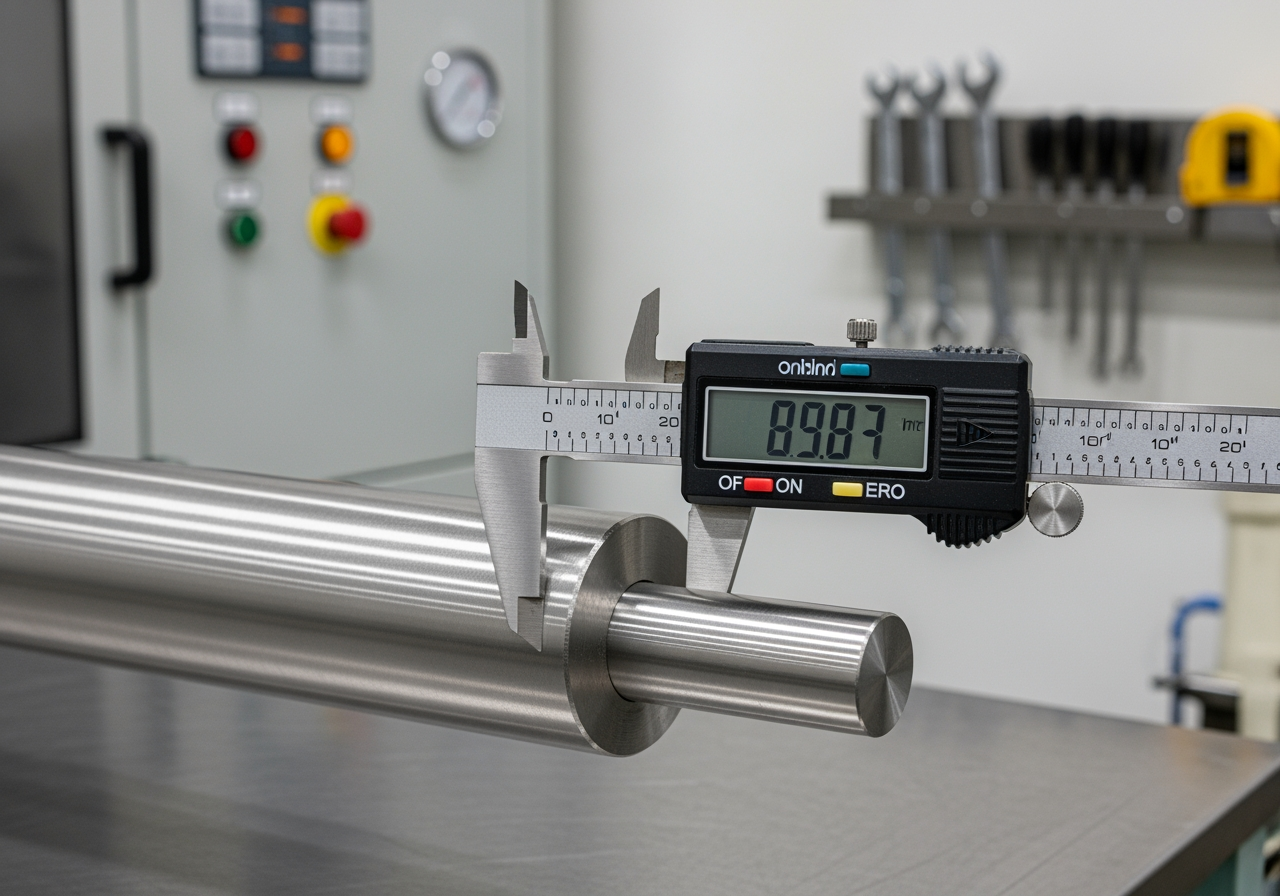
347 stainless steel bar offers an excellent strength-to-weight ratio and is non-magnetic in its annealed condition, which is important for applications with sensitive instruments. Surprisingly, 347 also has good low-temperature toughness, maintaining ductility in cryogenic conditions. This versatility across a wide temperature spectrum is a rare and valuable trait.
For full technical specifications, engineers can reference the ASM Material Data Sheet.
Chemical Composition
The performance of 347 stainless steel bar comes from its precise chemical composition, particularly the addition of niobium.
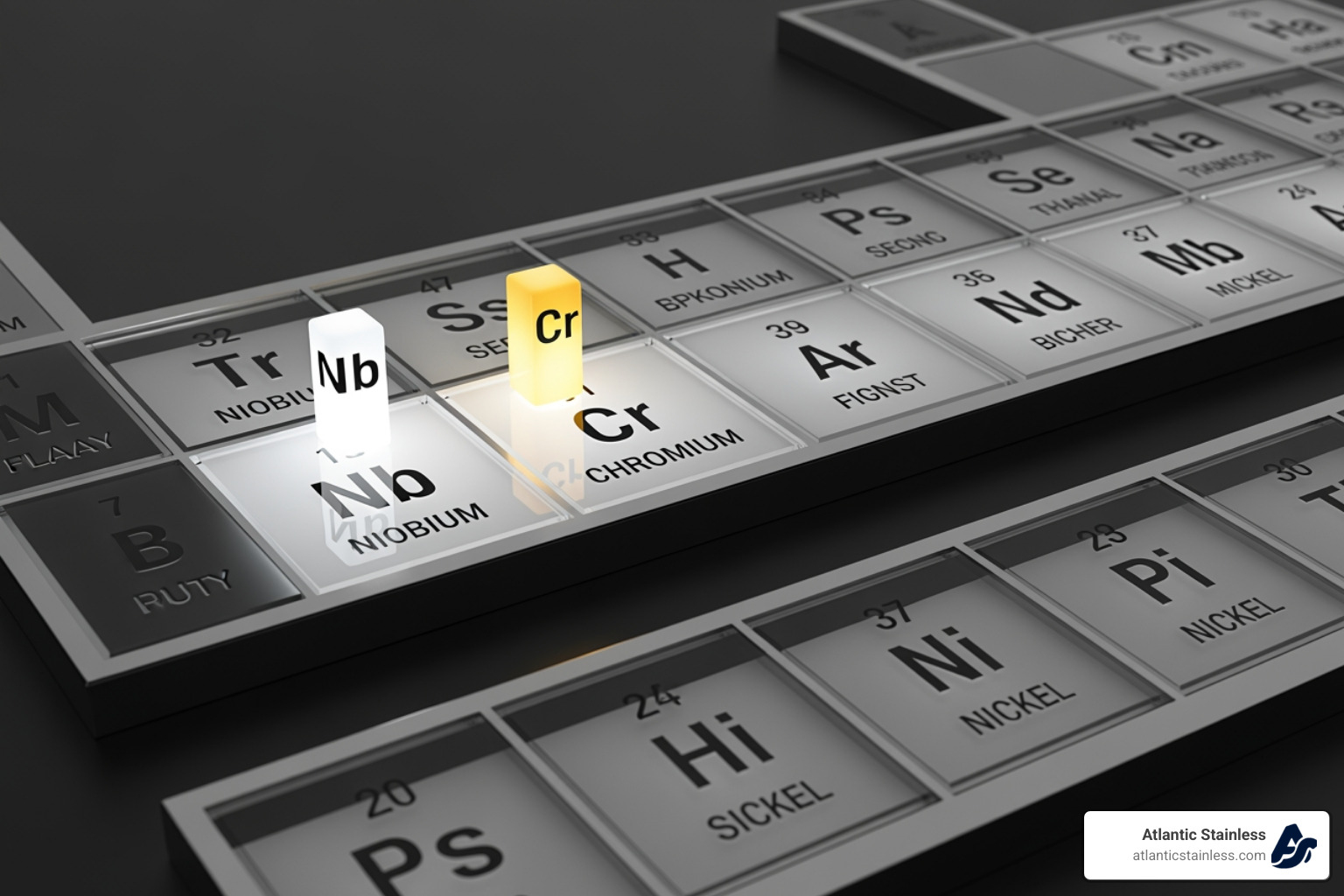
The alloy contains 17-19% chromium for corrosion resistance and 9-13% nickel to stabilize the austenitic structure, ensuring ductility and toughness. The key element is niobium (or columbium), present at a minimum of ten times the carbon content (up to 1%). It acts as a stabilizer, preventing intergranular corrosion by bonding with carbon before chromium can.
Other elements include carbon (0.08% max), manganese (2% max) for strength and hot workability, and silicon (0.75% max) for oxidation resistance. Impurities like phosphorus (0.045% max) and sulfur (0.030% max) are limited to maintain corrosion resistance and weldability. Iron makes up the balance of the composition.
Mechanical Properties of 347 stainless steel bar
The mechanical properties of 347 stainless steel bar define its performance under stress, especially at high temperatures.
In the annealed condition, 347 has a minimum tensile strength of 75 ksi (515 MPa), a minimum yield strength of 30 ksi (205 MPa), and a minimum elongation of 40% in 2 inches. This high elongation indicates excellent ductility, allowing it to be formed and absorb impacts without fracturing. Hardness is a maximum of 92 Rockwell B or 201 Brinell, indicating good resistance to wear.
While these properties are similar to 304 stainless steel, 347 excels in creep and stress rupture properties at liftd temperatures. The high-carbon variant, 347H, is engineered for even better performance above 1000 F (537 C), where resistance to creep (slow deformation under constant stress) is critical for components like boiler tubes and jet engine parts. Its excellent ductility provides a margin of safety, as the material will bend before it breaks.
Physical Properties
The physical properties of 347 stainless steel bar are critical for designing systems where thermal behavior, weight, or electrical characteristics are important.
- Density: 0.288 lbs/in³ (7.96 g/cm³), important for calculating component weight.
- Thermal Conductivity: Around 9.2 Btu/ft hr F (16.3 W/m-K) at 100 C. Its relatively low conductivity is an advantage where heat containment is desired.
- Coefficient of Thermal Expansion: Approximately 9.3 x 10^-6 in/in/F (16.6 um/m-K) from 32-212 F. This is a critical factor in designs with multiple materials to prevent stress from temperature changes.
- Electrical Resistivity: 28.4 microhm-in (72 microhm-cm) at 68 F.
- Melting Range: 2500-2550 F (1371-1400 C), underscoring its suitability for high-temperature service.
- Modulus of Elasticity (Stiffness): Approximately 28.0 x 10^6 psi (193 GPa). Its high modulus means it resists elastic deformation under load, which is vital for structural applications.
Primary Applications and Industries
347 stainless steel bar is the material of choice for extreme temperature and corrosive environments where standard grades are inadequate.
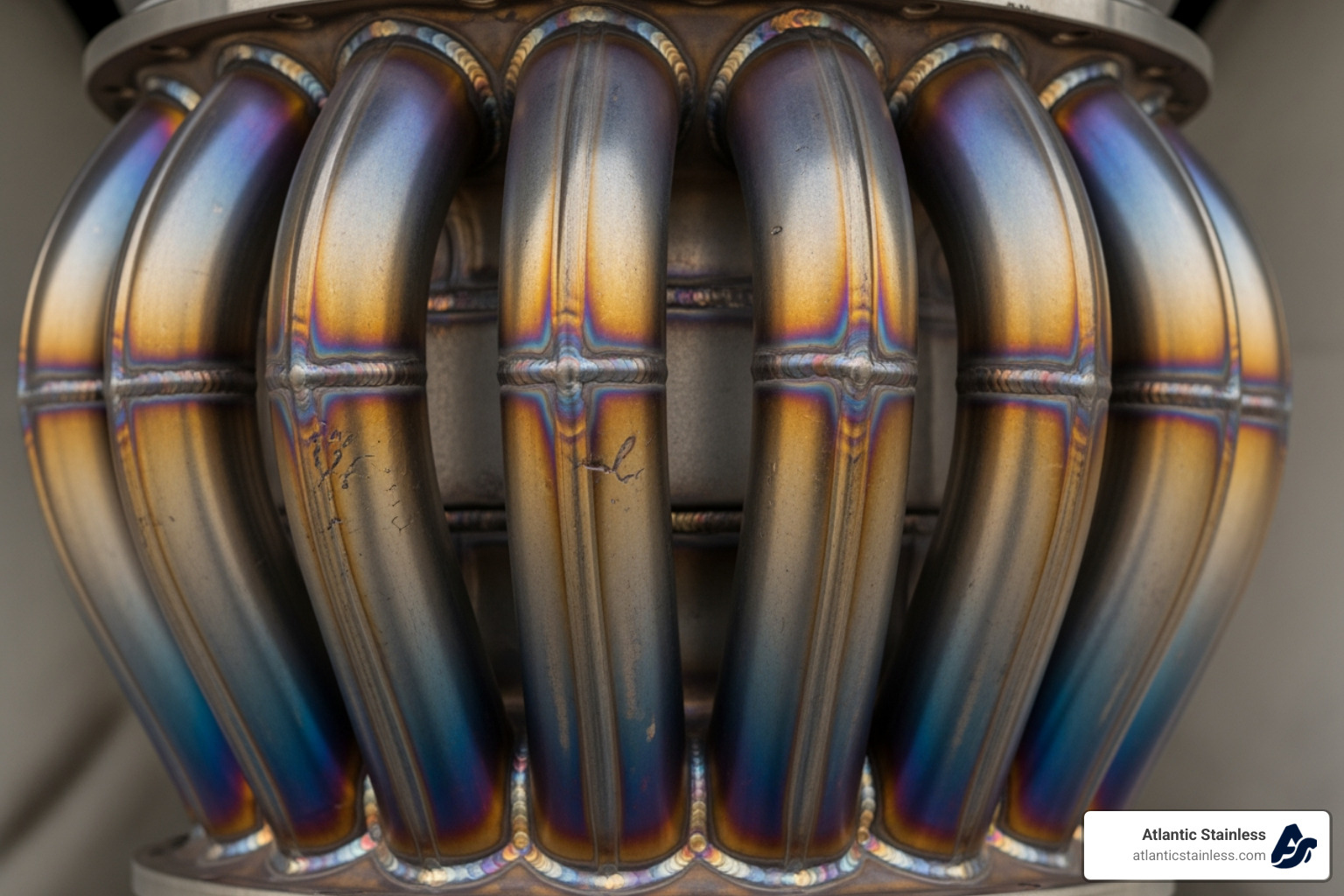
347 maintains its integrity and resists intergranular corrosion during intermittent heating up to 1650 F (899 C). It is especially valued for welded structures that cannot be post-weld heat treated and for its resistance to polythionic acid stress corrosion cracking in petroleum refining. In environments where failure is not an option—from handling superheated steam to jet engine components—347 delivers reliable performance.
For more information about the versatile family of alloys that 347 belongs to, check out our guide on 300 Series Stainless Steel.
Key Industries
The primary industries using 347 stainless steel bar face extreme temperature and corrosion challenges.
- Aerospace: Used for jet engine components and aircraft exhaust systems due to its critical high-temperature strength and oxidation resistance.
- Petroleum Refining: Relies on 347 for fluid catalytic cracking (FCC) units and piping, where its resistance to polythionic acid stress corrosion cracking is essential to prevent failures.
- Chemical Processing: Uses 347 for equipment handling hot, corrosive chemicals, particularly in welded structures.
- Power Generation: Uses it for boiler components, superheaters, and steam lines that require continuous high-temperature service.
- Automotive: The industry uses it for high-performance exhaust systems.
- Food Processing: It’s used for specialized high-temperature equipment.
Specific Use Cases
Specific applications for 347 stainless steel bar highlight its use in extreme engineering:
- Rocket engine parts and aircraft exhaust stacks, which demand performance at extreme temperatures.
- Boiler tubes and casings, radiant superheaters, and high-pressure steam pipes in power generation facilities.
- Heat exchanger tubes for efficient energy transfer in corrosive environments.
- Heavy-duty exhaust systems for industrial equipment and vehicles.
- Fluid catalytic cracking (FCC) units in petroleum refineries, where its resistance to polythionic acid stress corrosion cracking is critical.
- Distributor trays and thermowells in various process industries requiring high-temperature stability.
Fabrication, Weldability, and Available Forms
347 stainless steel bar is easy to fabricate using standard processes. It behaves similarly to other austenitic stainless steels but offers superior performance in demanding conditions.
347 is non-hardenable by heat treatment, but it responds well to cold working. Processes like rolling or bending can increase its hardness and tensile strength, allowing for property customization. Its combination of easy fabrication and high-temperature performance makes 347 a practical choice for complex assemblies.
For broader guidance on matching materials to your specific application, our Stainless Steel Material Selection Guide is worth a look.
Welding and Heat Treatment
The exceptional weldability of 347 stainless steel bar is a major advantage. Due to niobium stabilization, heavy sections can be welded without causing intergranular corrosion in the heat-affected zone, eliminating the need for post-weld annealing. This saves significant time and cost.
All standard fusion and resistance welding processes are suitable for 347. Use matching filler metals, such as AWS E347 or ER347, to ensure the weld maintains the base metal’s properties. No pre-heating is generally required, which streamlines the welding workflow.
For heat treatment, annealing is done by heating to 1800-2000 F (982-1093 C) and then rapid quenching to relieve stress and optimize corrosion resistance. Uniquely, stress relief annealing can be performed within the 800-1500 F carbide precipitation range without risking sensitization, thanks to niobium stabilization.
Common Forms and Sizes of 347 stainless steel bar
To suit various fabrication projects, 347 stainless steel bar is available in several common forms.
We stock 347 in round bar, square bar, and flat bar. Round bar is available in diameters from 3/8″ to 4″ and in standard lengths. Square and flat bars are also available in a range of common sizes.
Our inventory supports both small and large volume orders with short lead times. If you require custom sizes, contact us for solutions.
Frequently Asked Questions about 347 Stainless Steel
Here are answers to frequently asked questions about 347 stainless steel bar.
What standards does 347 stainless steel bar adhere to?
For critical applications, 347 stainless steel bar must adhere to industry standards that guarantee its quality and properties.
347 stainless steel bar is manufactured to standards including ASTM A276 (bars and shapes) and ASTM A479 / ASME SA479 (bars for boilers and pressure vessels). For aerospace, it often meets AMS 5646. The alloy is designated as UNS S34700 (or UNS S34709 for the 347H variant) and EN 1.4550 in Europe. ASTM A240 covers plate, sheet, and strip forms. These standards ensure the material will perform as expected in demanding applications.
What are the main advantages of using 347 stainless steel?
The main advantage of 347 stainless steel bar is its excellent resistance to intergranular corrosion (sensitization) after high-temperature exposure. The niobium stabilization prevents corrosion in welded equipment operating between 800-1500 F, eliminating the need for post-weld annealing and saving significant fabrication time and cost.
It also offers superior creep and stress rupture properties compared to 304, meaning it better resists deformation and failure under long-term stress at liftd temperatures. This is critical for continuous high-temperature service.
Its outstanding weldability allows for the use of all standard welding processes. The welds resist intergranular corrosion without additional heat treatment, leading to faster and more reliable fabrication.
Finally, 347 has good oxidation resistance up to 1500 F and resists polythionic acid stress corrosion cracking, a key requirement in petroleum refining. This combination of properties makes it essential for oil refining, chemical processing, and power generation.
Are there any limitations to using 347 stainless steel?
347 stainless steel bar has limitations, and understanding them ensures proper material selection.
A significant limitation is its poor performance in chloride solutions. Like 304, it is susceptible to pitting and crevice corrosion. For environments with high chloride content, such as seawater, grades like 316/316L or duplex stainless steels are better choices.
It can also be vulnerable to stress corrosion cracking in hot chloride environments, a common issue for most austenitic stainless steels.
For fabrication, 347 cannot be hardened by heat treatment. It can be strengthened through cold working, but if very high hardness is required, other alloy families should be considered.
Finally, cost is a factor. The addition of niobium makes 347 stainless steel bar more expensive than 304. While this premium is justified for its unique high-temperature properties, it may not be economical for general-purpose applications.
Understanding these limitations doesn’t diminish 347’s value—it simply ensures you’re using this remarkable alloy where it truly shines. For more guidance on selecting the right material for your specific needs, check out our Stainless Steel Material Selection Guide.
Your Source for High-Performance 347 Stainless Steel
For projects demanding high-temperature strength, post-weld corrosion resistance, and reliability under pressure, 347 stainless steel bar is the solution. Its niobium stabilization is key to its performance, especially in heavy welded assemblies where post-weld heat treatment is not feasible.
The applications for 347—from rocket engines to refinery equipment—are critical environments where reliability is paramount and lesser alloys would fail.
Atlantic Stainless is your nationwide supplier for high-quality stainless steel and high-temperature alloys. We understand the demands of critical applications and maintain a comprehensive inventory of 347 Stainless Steel products. We are committed to prompt delivery and exceptional service, backed by our extensive industry experience.
Our 347 stainless steel bar inventory is ready for your aerospace, chemical, or refining project. We know timelines are critical and ensure material availability won’t be a bottleneck.
Our expert team can help you with specifications and material selection to ensure your project’s success. We’re more than a supplier; we’re your partner.
Contact us today for a quote on 347 stainless steel round bar and experience the difference that expertise, quality inventory, and genuine customer service can make for your next high-performance project.