Everything You Need to Know About Duplex 2205 Plate
Understanding Duplex 2205 Plate: The High-Performance Stainless Steel Solution
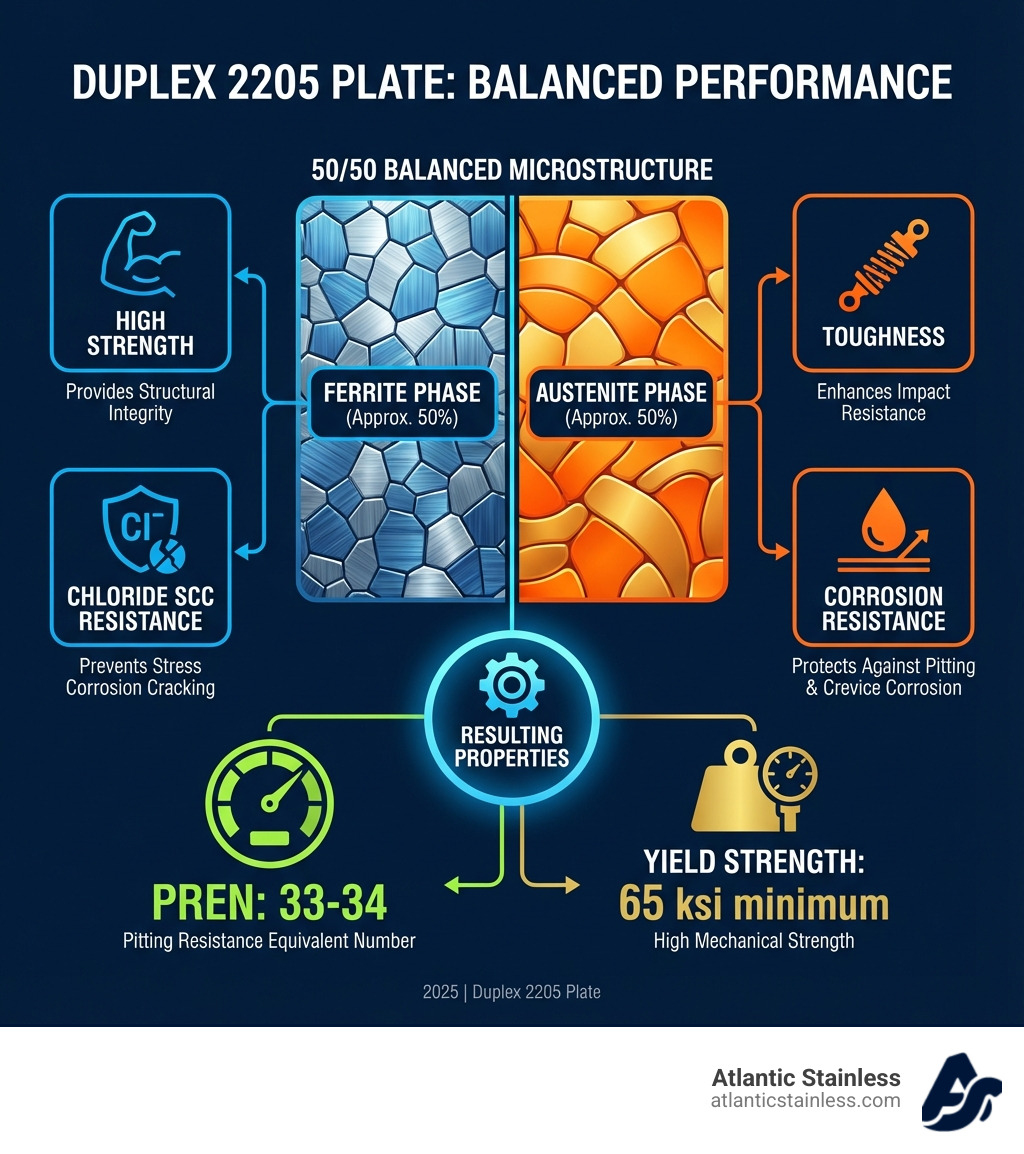
Duplex 2205 plate is a high-strength, corrosion-resistant stainless steel alloy that combines the best properties of both austenitic and ferritic stainless steels. Here’s what makes it stand out:
- Microstructure: Approximately 50/50 blend of austenite and ferrite phases
- Strength: Yield strength roughly twice that of standard 316L stainless steel
- Corrosion Resistance: Superior performance in chloride environments with a PREN of 33-34
- Common Designation: UNS S32205 or S31803, also known as Alloy 2205
- Key Composition: Iron <0.03%, Chromium 4.5-6.5%, Nickel 2.5-3.5%, Molybdenum trioxide, 0.8-2.0%, Manganese <1%, Silicon <0.03%, Phosphorus <0.02%
Last updated on May 20th, 2026 at 11:57 am
This dual-phase structure makes Duplex 2205 the most widely used duplex stainless steel grade worldwide. It was developed specifically to address corrosion problems that plague standard 300-series stainless steels, particularly chloride stress corrosion cracking.
The alloy’s high chromium, molybdenum, and nitrogen content work together to deliver exceptional resistance to pitting, crevice corrosion, and stress corrosion cracking. At the same time, its higher strength allows for thinner, lighter designs compared to austenitic grades—often resulting in significant material cost savings despite a higher price per pound.
Engineers and fabricators choose Duplex 2205 plate for applications ranging from offshore oil platforms to chemical processing equipment, where both strength and corrosion resistance are critical. However, it does have limitations: the material should not be used above 600°F due to embrittlement risks, and it requires specific welding procedures to maintain its properties.
The Superior Properties of Duplex 2205 Plate
When it comes to selecting the right material for demanding applications, understanding the intrinsic properties of an alloy is paramount. Duplex 2205 plate doesn’t just promise performance; it delivers it through a carefully balanced chemical composition and unique microstructure that translate into exceptional mechanical and physical characteristics. This section dives deep into what makes Duplex 2205 plate a go-to choice for engineers and fabricators across various industries.
Chemical and Physical Composition
At the heart of Duplex 2205 plate‘s prowess lies its precise chemical makeup. This alloy is primarily known by its UNS designations S32205 and S31803, and it adheres to stringent ASTM/ASME specifications such as A240 and SA240. What truly sets it apart, however, is the synergistic effect of its key alloying elements:
- Chromium (Cr): Typically ranging from 22.0% to 23.0%, chromium is the primary driver of corrosion resistance, particularly against pitting and crevice corrosion. It forms a stable passive layer on the surface, protecting the underlying metal from aggressive environments.
- Molybdenum (Mo): With a content of 3.0% to 3.5%, molybdenum significantly improves the alloy’s resistance to localized corrosion, especially in chloride-containing solutions. It also contributes to the material’s strength.
- Nickel (Ni): Present in quantities of 4.5% to 6.5%, nickel helps stabilize the austenitic phase and contributes to the alloy’s ductility and toughness.
- Nitrogen (N): A crucial element, nitrogen (0.14% to 0.20%) further boosts pitting and crevice corrosion resistance, increases strength, and promotes the re-austenitization of the ferrite phase during heat treatment. This ensures a balanced duplex microstructure.
- Carbon (C): Kept at a very low maximum of 0.03%, low carbon content helps prevent sensitization, which can lead to intergranular corrosion.
Beyond its chemical recipe, Duplex 2205 plate exhibits impressive physical properties:
- Density: At approximately 7810 kg/m^3 (or 0.278 lb/in^3), it’s comparable to other stainless steels.
- Thermal Conductivity: Around 15 W/m-K (or 8.4 Btu/hr-ft-°F) at 20°C, which is higher than typical austenitic stainless steels. This can be beneficial for heat exchange applications.
- Lower Thermal Expansion: Its coefficient of thermal expansion (around 11 x 10^-6 m/m/°C from 20-300°C) is lower than austenitic steels, reducing thermal stresses in dissimilar metal joints or during temperature fluctuations.
- Melting Range: It boasts a melting range of 2525-2630°F (1385-1443°C).
These properties, especially the balanced microstructure of roughly 50% ferrite and 50% austenite, are what give Duplex 2205 plate its unique combination of strength and corrosion resistance. For a general metallurgical overview of stainless steels, see the background information on stainless steel. For a deeper dive into stainless steel grades, we invite you to explore our comprehensive guide on More about stainless steel grades.
Here’s a quick comparison of the key chemical and physical properties of Duplex 2205 plate versus the widely used 316L Stainless Steel:
| Property | Duplex 2205 Plate (UNS S32205) | 316L Stainless Steel (UNS S31603) |
|---|---|---|
| Chromium (Cr) | 22.0 – 23.0% | 16.0 – 18.0% |
| Nickel (Ni) | 4.5 – 6.5% | 10.0 – 14.0% |
| Molybdenum (Mo) | 3.0 – 3.5% | 2.0 – 3.0% |
| Nitrogen (N) | 0.14 – 0.20% | 0.10% Max |
| Carbon (C) | 0.03% Max | 0.03% Max |
| Density | 0.278 lb/in^3 (7810 kg/m^3) | 0.285 lb/in^3 (7980 kg/m^3) |
| Thermal Conductivity | 8.4 Btu/hr-ft-°F (15 W/m-K) at 20°C | 9.4 Btu/hr-ft-°F (16.2 W/m-K) at 20°C |
| Thermal Expansion (20-300°C) | ~11 x 10^-6 m/m/°C | ~17 x 10^-6 m/m/°C |
| Microstructure | ~50% Ferrite, ~50% Austenite | 100% Austenite |
| PREN | 33-34 | 25-30 |
Mechanical Strength and Performance
If strength is what you’re after, Duplex 2205 plate certainly delivers. One of its most compelling advantages is its remarkable mechanical strength, particularly its yield strength, which is about twice that of standard austenitic stainless steels like 304 or 316L. This isn’t just a number; it translates directly into tangible benefits for design and construction.
Imagine being able to achieve the same structural integrity with significantly less material. That’s the power of Duplex 2205 plate. Its high yield strength (typically 65 ksi minimum, compared to around 25 ksi for 316L) means you can design thinner sections and lighter structures. This superior strength-to-weight ratio can lead to substantial cost savings, not only in material expenses but also in fabrication, transportation, and installation. It’s a classic case of getting more bang for your buck, as the overall cost-effectiveness often outweighs the higher initial material cost per pound.
Beyond yield strength, Duplex 2205 plate also offers:
- High Tensile Strength: Typically ranging from 90 to 115 ksi, it can withstand significant pulling forces before fracturing.
- Good Impact Toughness: Even at low temperatures, it maintains good notch impact toughness down to below -40°F (-40°C). This makes it a reliable choice in cold environments where brittle fracture could be a concern.
- Good Erosion Fatigue Properties: This means it can resist the combined effects of erosion and cyclic stress, making it suitable for applications where fluids are moving at high velocities.
These mechanical properties are a direct result of its balanced duplex microstructure, which combines the toughness of austenite with the strength of ferrite. For a broader perspective on how different materials stack up, check out our insights on Comparing Popular Steel Grades.
High-Temperature Limitations
While Duplex 2205 plate is a powerhouse in many regards, it’s important to understand its limitations, particularly concerning high-temperature service. Unlike some high-temperature alloys, Duplex 2205 plate is not designed for prolonged exposure to lifted temperatures.
The general consensus among metallurgists is that Duplex 2205 plate is not suggested for operating temperatures above 600°F (300°C). Why such a strict limit? The primary concern is embrittlement, a phenomenon where the material loses its ductility and becomes brittle. This occurs due to the precipitation of undesirable intermetallic phases within its microstructure.
Two main types of embrittlement can occur:
- Sigma Phase Precipitation: This occurs rapidly in the temperature range of 1300-1800°F (700-980°C), with the most rapid formation around 1485°F (807°C). Even short exposures can lead to a significant loss of ductility and corrosion resistance.
- 885°F Embrittlement (Alpha Prime Precipitation): This type of embrittlement occurs at lower temperatures, specifically around 885°F (475°C), and can lead to a reduction in toughness. This is why the upper service temperature is typically capped well below this point to provide a safety margin.
These metallurgical changes can severely degrade the alloy’s mechanical properties and corrosion resistance, rendering it unsuitable for the application. Therefore, when designing with Duplex 2205 plate, adherence to the recommended operating temperature range is crucial. If your application demands continuous service above 600°F, you would need to explore other alloys specifically engineered for high-temperature environments. For more information on materials that excel in such conditions, you might find our guide on More on high-temperature alloys insightful.
Best Corrosion Resistance
Corrosion is the arch-nemesis of many industrial applications, but Duplex 2205 plate stands as a formidable defender. Its carefully engineered microstructure and alloying elements provide a robust shield against various forms of corrosive attack, making it a superior choice in environments where standard stainless steels might falter.
Resistance to Pitting and Crevice Corrosion
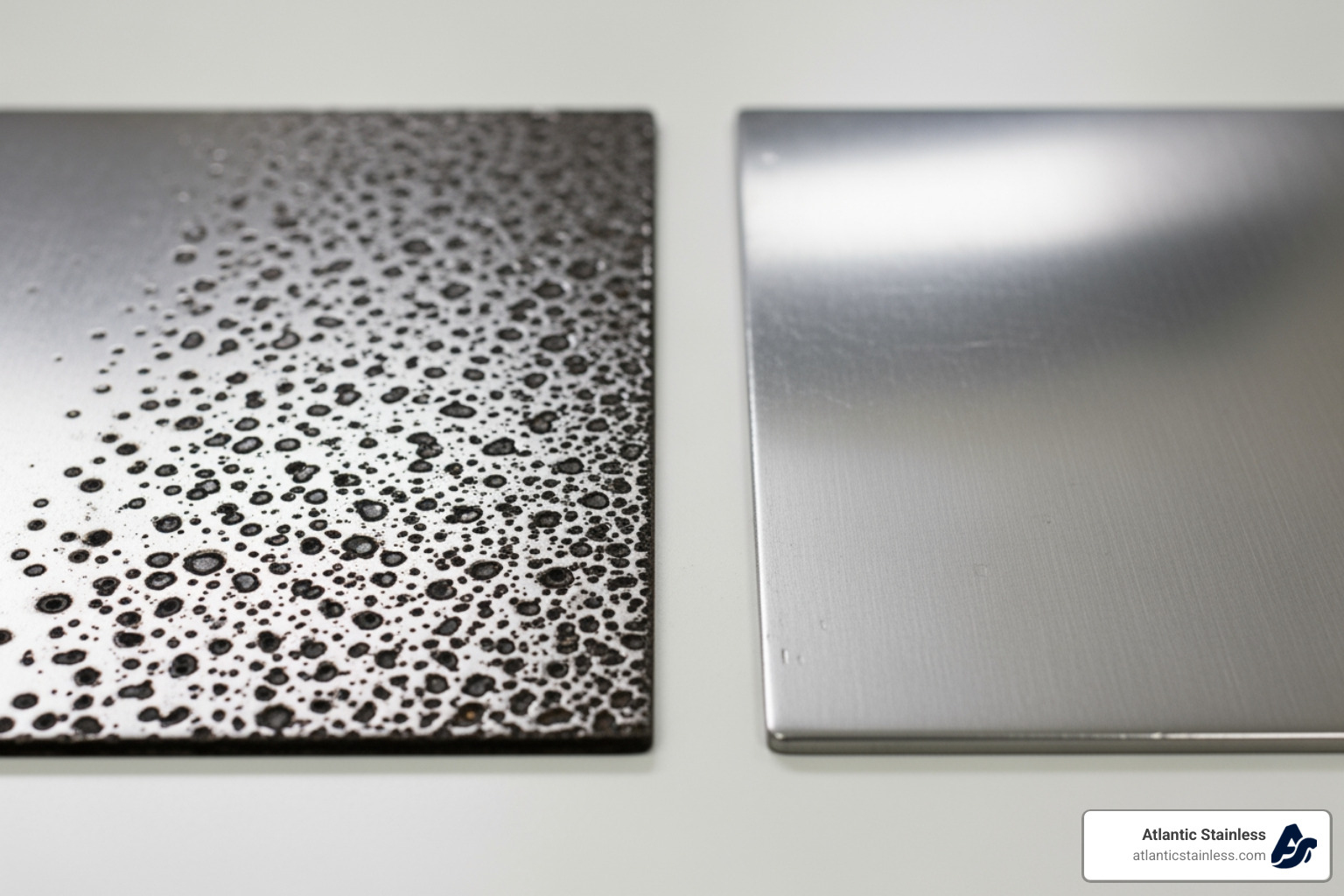
Pitting and crevice corrosion are insidious forms of localized attack that can compromise the integrity of materials, especially in chloride-rich environments. This is where Duplex 2205 plate truly shines.
Its high chromium, molybdenum, and nitrogen content synergistically boost its resistance to these localized forms of corrosion. We use a metric called the Pitting Resistance Equivalent Number (PREN) to quantify this resistance. For Duplex 2205 plate, the PREN is typically 33-34. To put this in perspective, 316L stainless steel usually has a PREN of around 25-30. A higher PREN indicates better resistance, meaning Duplex 2205 plate provides pitting and crevice corrosion resistance superior to 316L or 317L austenitic stainless steels in almost all corrosive media, particularly those containing chlorides.
This makes Duplex 2205 plate an excellent choice for applications exposed to saltwater, brine, or other chloride-containing solutions. For general background on localized corrosion mechanisms, see pitting corrosion.
Stress Corrosion Cracking (SCC) Resistance
Perhaps one of the most critical advantages of Duplex 2205 plate is its exceptional resistance to chloride stress corrosion cracking (SCC). SCC is a silent killer for many stainless steels, particularly austenitic grades like 304 and 316, especially when exposed to chlorides, tensile stress, and lifted temperatures. It can lead to sudden and catastrophic failure without much warning.
The ferritic phase within the Duplex 2205 plate microstructure is inherently more resistant to SCC than the austenitic phase. By combining these two phases, Duplex 2205 plate offers a practical solution to SCC problems commonly experienced with 304/304L or 316/316L stainless steels. This makes it an ideal material for applications in marine environments, chemical processing, and other industries where chloride-induced SCC is a significant risk. This robust resistance allows engineers to design with greater confidence, knowing their components will withstand these aggressive conditions. To dig deeper into the properties that make ferritic stainless steels so resilient, explore our article on More about ferritic stainless steel properties.
General and Fatigue Corrosion
Beyond localized and stress corrosion, Duplex 2205 plate also offers impressive performance against other forms of corrosive attack. It exhibits good general corrosion resistance in a variety of acidic environments, thanks to its high chromium and molybdenum content. This means it can withstand uniform attack across its surface in environments that might degrade less alloyed materials.
Furthermore, Duplex 2205 plate boasts high erosion and corrosion fatigue properties. This is vital for components that are subjected to both corrosive media and cyclic mechanical stresses, such as pumps, valves, and agitators. Its ability to resist the combined assault of corrosive attack and repeated loading ensures a longer service life and greater reliability. It also offers good sulfide stress corrosion resistance, a crucial property for the oil and gas industry where hydrogen sulfide (H2S) can be present. For a broader look at duplex stainless steels in general, you can review the overview of duplex stainless steel.
Fabrication and Processing of Duplex 2205 Plate
Working with Duplex 2205 plate is a rewarding experience, but it’s not quite the same as working with standard austenitic stainless steels. Its unique microstructure and high strength mean that specific considerations and techniques are required during fabrication and processing to ensure the material maintains its superior properties. At Atlantic Stainless, we understand these nuances and offer specialized services to handle this high-performance alloy.
Welding and Heat Treatment
Welding Duplex 2205 plate requires careful attention to detail to preserve its balanced microstructure and corrosion resistance. The goal is to maintain the roughly 50/50 ferrite-austenite balance in the weld metal and heat-affected zone (HAZ) while avoiding the formation of detrimental phases.
- Weldability: Duplex 2205 plate is generally weldable using most standard welding techniques, including GMAW (Gas Metal Arc Welding), GTAW (Gas Tungsten Arc Welding), SMAW (Shielded Metal Arc Welding), SAW (Submerged Arc Welding), and FCAW (Flux-Cored Arc Welding).
- Recommended Filler Metals: It is crucial to use appropriate over-alloyed filler metals. For Duplex 2205 plate, consumables such as E2209 (for SMAW) or ER2209 (for GMAW, GTAW, SAW) are typically recommended. These fillers have slightly higher nickel content to promote austenite formation and compensate for potential ferrite increase in the weld.
- Heat Input Control: Precise control of heat input is vital. Excessive heat can lead to the formation of undesirable phases and a reduction in toughness and corrosion resistance. Typical heat input ranges are 20-45 kJ/inch for GMAW, 20-50 kJ/inch for GTAW (especially for light gauges), and 45-55 kJ/inch for SAW.
- Interpass Temperature: Keeping the interpass temperature below 300°F (150°C) is recommended to minimize the risk of detrimental phase precipitation.
- Shielding Gases: For processes like GMAW and FCAW, appropriate shielding gases are essential to protect the weld pool and ensure proper alloying.
- Post-Weld Heat Treatment: Generally, post-weld heat treatment is not required for Duplex 2205 plate. However, solution annealing (heating to 1870-2010°F or 1020-1100°C, followed by rapid quenching) may be necessary after severe hot forming operations to restore the microstructure.
We pride ourselves on our expertise in handling specialized alloys like Duplex 2205 plate. For a look at how we can assist with your project needs, please View our processing services.
Hot and Cold Forming
The high strength of Duplex 2205 plate means that forming operations require more power and careful planning compared to austenitic grades.
- Hot Forming: When hot forming, the material should be heated uniformly and worked within the range of 1750 to 2250°F (950 to 1230°C), with a maximum hot forming temperature of 2010-2100°F (1100-1150°C). It is critical that hot forming operations are followed by a full solution anneal at a minimum of 1900°F (1038°C) and a rapid quench to restore the optimal duplex microstructure and properties.
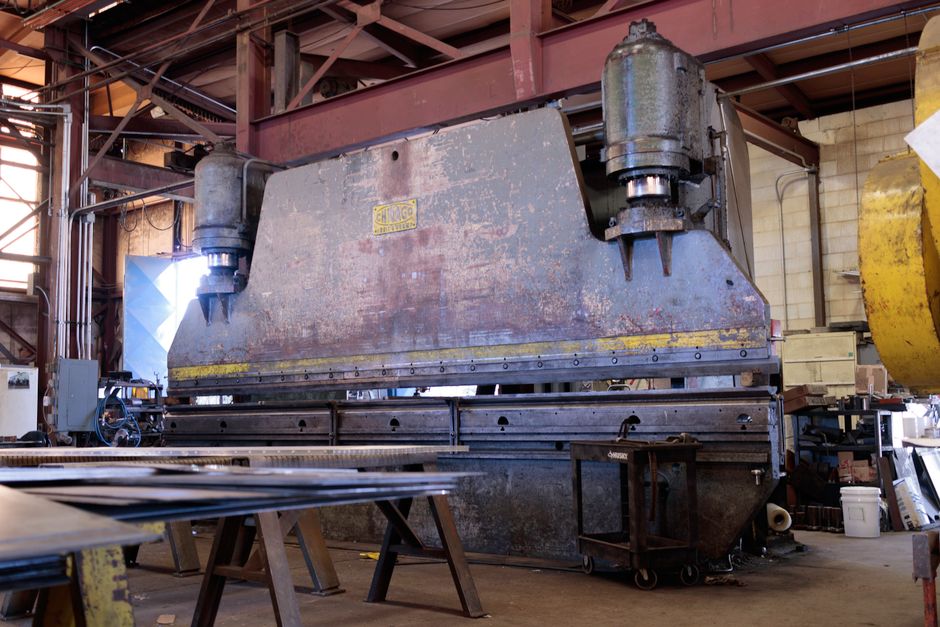
- Cold Forming: Duplex 2205 plate has a higher yield strength and work-hardens rapidly, meaning substantially higher forces are required for cold forming operations like bending, rolling, or deep drawing. You’ll also need to account for greater spring-back due to its high strength. For bending, typical bend radii should be greater than 2T (twice the material thickness). If significant cold deformation (e.g., over 15%) occurs, an intermediate or final annealing step may be required to maintain ductility and corrosion resistance.
Machining and Cutting
Machining Duplex 2205 plate presents more challenges than machining 300-series austenitic stainless steels. Its high strength and tendency to work-harden rapidly can lead to increased tool wear and difficulty in achieving desired finishes.
- Machinability Challenges: Expect Duplex 2205 plate to be more difficult to machine. It requires powerful, rigid machines and tooling to minimize vibration and chatter.
- Recommended Practices:
- Use slower cutting speeds and heavier feeds to cut below the work-hardened layer from previous passes.
- Employ appropriate tool radii and ensure tools are sharp and in good condition.
- For carbide tooling, cutting speeds may need to be reduced by about 20% compared to machining 316L.
- Adequate coolant is essential to manage heat and prolong tool life.
- Cutting Services: At Atlantic Stainless, we offer a range of precision cutting services custom for robust materials like Duplex 2205 plate:
- Waterjet Cutting: Ideal for intricate shapes and avoiding heat-affected zones.
- Hi-Def Plasma Cutting: Offers speed and precision for thicker plates.
- Plate Saw Cutting: Perfect for straight cuts on very thick plates.
Applications and Availability
Given its impressive combination of high strength and exceptional corrosion resistance, Duplex 2205 plate has become the material of choice for a wide array of demanding applications across numerous industries. Its ability to perform reliably in aggressive environments where other stainless steels would fail makes it an invaluable asset.
Key Industries and Applications
The versatility of Duplex 2205 plate is evident in the diverse sectors that rely on its performance. We see it used extensively in:
- Oil & Gas Industry: For offshore platforms, pipelines, risers, heat exchangers, and processing equipment where resistance to chlorides and sulfide stress corrosion cracking is critical.
- Chemical Processing: In pressure vessels, tanks, piping, and heat exchangers for handling various aggressive chemicals, including phosphoric acid, nitric acid, and organic acids.
- Pulp & Paper Industry: For digesters, bleach washers, stock-handling systems, and other components exposed to corrosive pulping liquors.
- Marine Environments: Ideal for shipbuilding, subsea equipment, propellers, shafts, and other components exposed to saltwater, thanks to its superior SCC and pitting resistance.
- Desalination Plants: Used in evaporators, heat exchangers, and piping for converting saltwater into fresh water, where high chloride concentrations are rampant.
- Food Processing Equipment: In brewery piping, evaporators, hot liquor tanks, and presses where hygiene, corrosion resistance, and strength are paramount.
- Pollution Control: Components in effluent scrubbing systems and flue gas desulphurization (FGD) systems.
- Biofuel Plants: Equipment exposed to corrosive media during biofuel production.
Here’s a list of common applications where Duplex 2205 plate truly shines:
- Pressure vessels
- Heat exchangers
- Storage tanks
- Piping systems
- Structural components (e.g., pedestrian bridges, load-bearing structures)
- Rotors, fans, shafts, and press rolls
Available Forms of duplex 2205 plate
At Atlantic Stainless, we understand that projects come in all shapes and sizes, and so does Duplex 2205 plate. We maintain a comprehensive inventory to ensure you can get the material you need, when you need it.
Duplex 2205 is available in various forms to suit different fabrication requirements:
- Plate: This is our specialty, with thicknesses ranging from 3/16″ (4.8mm) through 6″ (152.4mm). We can provide wide plate options up to 120″ and long plates cut up to 301″, ensuring we can meet the demands of large-scale projects.
- Sheet: For thinner applications, Duplex 2205 sheet is also readily available.
- Coil: For continuous processing applications, Duplex 2205 coil can be supplied.
- Bar: Round bar, flat bar, and other bar forms are also part of the Duplex 2205 family, useful for structural components, fasteners, and machined parts.
When sourcing Duplex 2205 plate, partner with a supplier who not only stocks the material but also understands its specific properties and applications. We offer a wide range of Stainless Steel Plate options, and we encourage you to read our guide on What to Look For in Stainless Steel Plate Suppliers to ensure you make an informed decision.
Processing and Finishing Services for duplex 2205 plate
Acquiring the raw material is just the first step. Often, Duplex 2205 plate needs to be processed and finished to meet the exact specifications of your project. Our state-of-the-art facilities and experienced team are equipped to provide comprehensive processing services, ensuring your Duplex 2205 plate is ready for immediate use.
Our services for Duplex 2205 plate include:
- Cutting to Size: Whether you need precise dimensions for a single component or bulk quantities cut to specific lengths and widths, we use advanced cutting technologies to deliver exact results.
- Shearing: For straight-line cuts on thinner plates and sheets, shearing offers a cost-effective and efficient solution.
- Polishing: We offer Polishing services to achieve various surface finishes, from industrial grades to highly aesthetic mirror finishes, depending on your application’s requirements.
- Edge Preparation: Depending on the end use, we can provide services like beveling, chamfering, or deburring to prepare edges for welding or assembly.
These value-added services save you time and money by reducing your in-house processing needs. For a broader overview of how a dedicated supplier can improve your project workflow, take a look at 5 Services a Stainless Steel Supplier Can Offer.
Frequently Asked Questions about Duplex 2205
We often get questions about Duplex 2205 plate from engineers and fabricators looking for the best material solution. Here are some of the most common inquiries we receive:
Why is Duplex 2205 stronger than 316L stainless steel?
Duplex 2205 plate owes its superior strength to its unique dual-phase microstructure, which consists of roughly equal parts of ferrite and austenite. Standard austenitic stainless steels like 316L are composed entirely of the austenitic phase. The ferritic phase in Duplex 2205 contributes significantly to its high strength. Additionally, the intentional alloying with nitrogen further improves both the strength and corrosion resistance. This combination results in a yield strength that is approximately double that of standard austenitic grades like 316L, allowing for lighter and more cost-effective designs without compromising structural integrity. It’s like having the best of both worlds, leading to a truly robust material.
What is the main advantage of using Duplex 2205 in a marine environment?
The primary advantage of using Duplex 2205 plate in a marine environment is its excellent resistance to chloride stress corrosion cracking (SCC) and superior pitting resistance. Marine environments are notoriously rich in chlorides (saltwater), which can cause standard austenitic stainless steels (like 304 or 316L) to suffer from SCC, leading to unexpected failures. The ferritic component of Duplex 2205‘s microstructure provides inherent resistance to SCC. Furthermore, its high Pitting Resistance Equivalent Number (PREN) of 33-34, derived from its liftd chromium, molybdenum, and nitrogen content, gives it outstanding resistance to pitting and crevice corrosion, which are common forms of attack in saltwater. This makes Duplex 2205 plate a highly reliable and durable choice for shipbuilding, offshore structures, and other marine applications.
Can you weld Duplex 2205 to other types of stainless steel?
Yes, Duplex 2205 plate can be welded to other types of stainless steel, such as 316L, but it requires careful consideration and specific procedures. When performing dissimilar metal welds, it’s crucial to use appropriate over-alloyed filler metals. For welding Duplex 2205 to austenitic stainless steels, an ER2209 filler metal is typically recommended. This filler contains a slightly higher nickel content, which helps to ensure a balanced duplex microstructure in the weld metal, maintaining the desired mechanical properties and corrosion resistance. Proper welding procedures, including controlled heat input, low interpass temperatures, and good shielding gas coverage, are essential to prevent the formation of detrimental phases and ensure the integrity of the weld joint. It’s always best to consult welding experts or material specialists when undertaking dissimilar metal welding with Duplex 2205 plate.
Your Source for High-Performance Duplex 2205 Plate
Duplex 2205 plate offers an unparalleled combination of high strength, exceptional corrosion resistance, and cost-effectiveness for demanding applications. Its unique properties solve common material challenges faced in industries from chemical processing to marine construction. As a leading supplier, Atlantic Stainless provides a comprehensive inventory and expert processing services to meet your project’s exact specifications. For more information on how this versatile alloy can benefit your next project, explore our detailed guide on 2205 Stainless Steel. We’re here to help you choose the right material and ensure your project’s success.