From Mill to Masterpiece: Exploring Hot and Cold Rolled Stainless Steel Sheets
Understanding the Manufacturing Journey of Rolled Stainless Steel Sheet
Last updated on March 19th, 2026 at 12:06 pm
Rolled stainless steel sheet is a flat-rolled product created by compressing stainless steel through a series of rollers to achieve consistent thickness and desired surface characteristics. This process—either hot rolling at high temperatures or cold rolling at room temperature—fundamentally shapes the material’s properties, appearance, and suitability for different applications.
Key differences between hot and cold rolling:
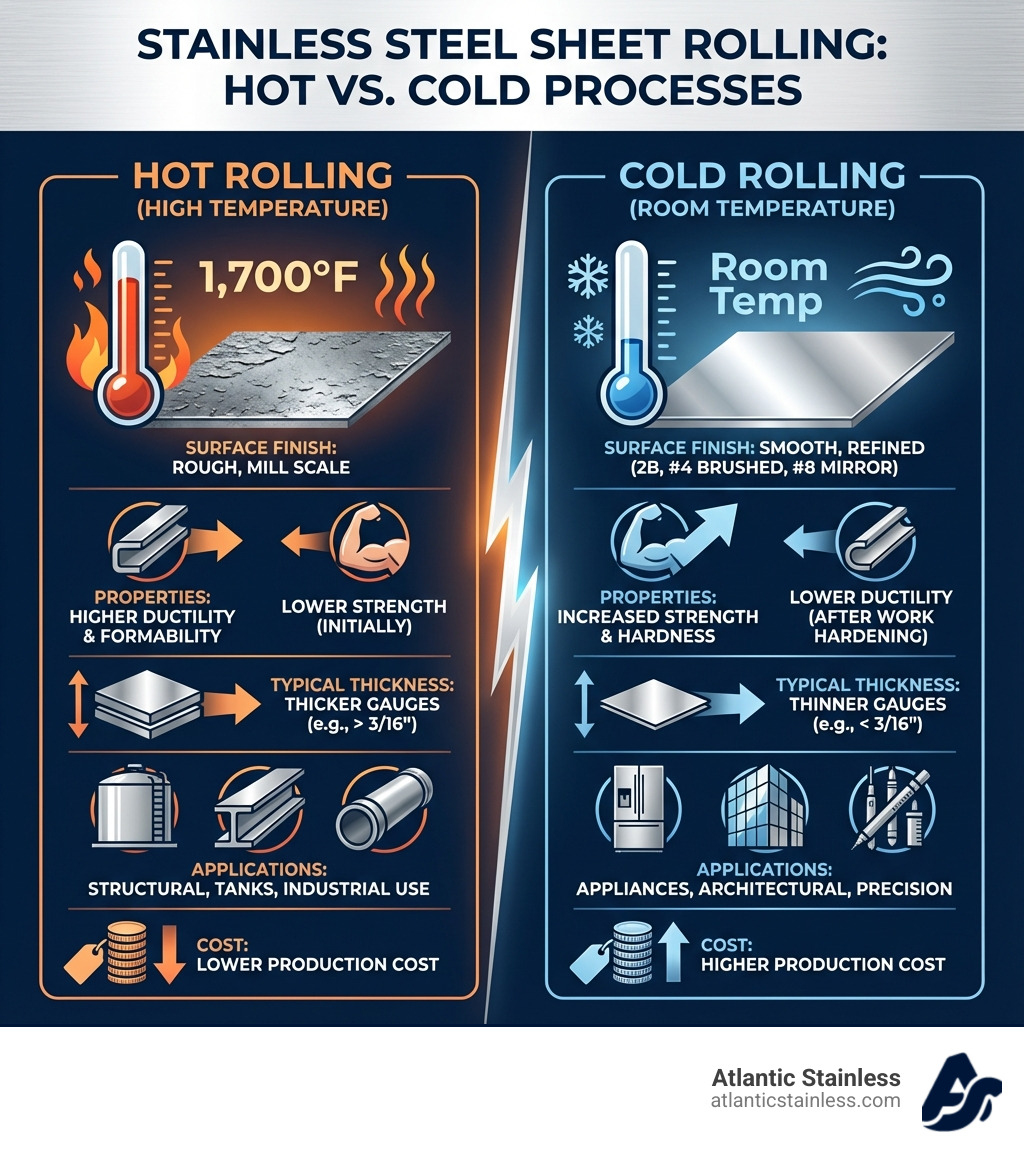
Hot Rolling: Processes steel at high temperatures (typically above 1,700°F), producing a scaly surface finish with lower cost but less precise tolerances. Best for structural components, tanks, and applications where surface appearance is secondary.
Cold Rolling: Processes steel at room temperature, creating smoother surfaces, tighter tolerances, and increased strength. Ideal for appliances, architectural details, and applications requiring superior finish quality.
Surface Finishes: Hot-rolled sheets typically have a rough, scaled finish (mill scale), while cold-rolled sheets offer refined finishes like 2B (dull), #4 (brushed), or #8 (mirror).
Properties: Cold rolling increases strength and hardness through work hardening, while hot rolling maintains greater ductility and formability.
If you’re specifying material for a commercial kitchen, you’ll likely need a cold-rolled sheet with a #4 brushed finish. For an industrial storage tank where corrosion resistance matters more than appearance, hot-rolled material often provides the most cost-effective solution.
Stainless steel’s versatility stems from its composition—primarily iron with at least 10.5% chromium. That chromium forms a passive oxide layer that protects against corrosion, rust, and staining. The rolling process then transforms this corrosion-resistant alloy into sheets ranging from thin gauge material (.010″ thick) to heavy plate (over 3/16″ thick), each suited for specific industrial, architectural, or manufacturing applications.
Understanding the differences between hot and cold rolling helps you select material that meets your project’s technical requirements while optimizing cost and performance.
The Rolling Process: How Stainless Steel Sheets Are Made
The journey of a rolled stainless steel sheet from raw material to finished product is a fascinating one, deeply impacting its final properties and suitability for various uses. It all starts with stainless steel slabs or billets, which then undergo either hot or cold rolling. The manufacturing process of rolling stainless steel sheets significantly affects its properties and applications, making this choice crucial for any project.
How Hot Rolling Affects Properties and Applications
Hot rolling involves processing stainless steel at extremely high temperatures, typically above 1,700°F (927°C). At these temperatures, the steel is easier to form and shape. The material passes through large rollers, progressively reducing its thickness. This high-temperature processing allows for recrystallization, meaning the grain structure of the steel reforms during the rolling process, preventing work hardening and maintaining the material’s ductility.
The primary advantages of hot rolling are its lower cost and the ability to produce larger sections. However, the high temperatures also lead to the formation of a dark, rough layer on the surface known as “mill scale.” While this scale can be removed through processes like pickling (acid bathing) and annealing (heat treatment followed by controlled cooling to improve ductility and reduce hardness), the resulting surface is typically not as smooth or aesthetically pleasing as cold-rolled material.
Hot-rolled stainless steel sheets are generally used in applications where surface finish is not critical, or where further processing (like machining or grinding) will refine the surface. Common applications include structural components, industrial tanks, and farm implements. Its cost-effectiveness and good formability make it ideal for heavy-duty applications where strength and bulk are prioritized over cosmetic appearance. When considering the environmental impact of hot rolling, it’s worth noting the energy intensity of the process. You can find more details about this in the Environmental product declaration – Hot rolled documentation.
How Cold Rolling Affects Properties and Applications
In contrast to hot rolling, cold rolling occurs at room temperature, below the steel’s recrystallization temperature. This process further reduces the thickness of previously hot-rolled and pickled material. Because the steel is processed cold, it requires more force, but it yields several significant advantages.
Cold rolling results in a much smoother, brighter, and more aesthetically pleasing surface finish. It also achieves tighter dimensional tolerances, meaning the thickness and flatness of the sheet are more precise. Furthermore, cold rolling increases the material’s strength and hardness through a phenomenon called work hardening. This means the material becomes stronger and more resistant to deformation, although it can also become less ductile.
This improved strength, superior surface finish, and precise dimensions make cold-rolled stainless steel sheets ideal for applications where aesthetics and accuracy are paramount. Think of kitchen appliances, architectural details, automotive body panels, and other components where a sleek, uniform appearance is desired. While the initial cost of cold-rolled material can be higher due to the additional processing steps, its superior properties often justify the investment for demanding applications. For those interested in the sustainability aspect, an Environmental product declaration – Cold rolled offers insights into its environmental footprint.
Common Grades and Their Intrinsic Properties
Stainless steel is not a single material but a family of alloys, each with a unique blend of elements that give it specific properties. The primary components are iron and a minimum of 10.5% chromium, which creates the protective passive layer. Beyond that, elements like nickel, molybdenum, manganese, and carbon are added to improve characteristics such as corrosion resistance, strength, formability, weldability, and heat resistance. These intrinsic properties are what make stainless steel suitable for rolling and a myriad of applications. Its hygienic qualities also make it a top choice for many industries. To dig deeper into selection, we offer a comprehensive Stainless Steel Material Selection Guide.
Type 304 vs. Type 316: The Two Most Popular Choices
When we talk about rolled stainless steel sheet, two grades almost always come up: Type 304 and Type 316. These austenitic stainless steels are incredibly versatile, but they have distinct differences that make them suitable for different environments.
| Feature | Type 304 Stainless Steel The term “stainless steel sheet” refers to a flat, thin form of stainless steel. These sheets are widely used across various industries due to their exceptional properties. Some primary uses include:
- Food and Beverage Industry: Given its hygiene and corrosion resistance, it’s extensively used for food processing equipment, food-grade storage, kitchen appliances, countertops, backsplashes, and sinks. Type 304 is often chosen for general use, while Type 316 is preferred in environments with higher chloride content, such as canning facilities.
- Medical and Healthcare: Its biocompatibility and ease of sterilization make it ideal for surgical instruments, medical equipment, hospital fixtures, and dental tools.
- Architecture and Construction: For both aesthetic appeal and durability, it’s used in building facades, roofing, wall panels, elevator interiors, handrails, and decorative elements.
- Automotive and Transportation: Components like exhaust systems, trim, grills, and structural parts benefit from its strength and corrosion resistance.
- Chemical and Pharmaceutical Processing: Its resistance to aggressive chemicals makes it crucial for tanks, pressure vessels, storage containers, process piping, and machinery components.
- Energy and Power Generation: Used in components for solar panels, wind turbines, hydroelectric power plants, and other energy systems.
- Industrial and Manufacturing: General machinery components, equipment enclosures, and various fabrication projects.
A Guide to Rolled Stainless Steel Sheet Specifications
When sourcing rolled stainless steel sheet, understanding the specifications is paramount. We always recommend considering key standards like ASTM A240, which covers chromium and chromium-nickel stainless steel plate, sheet, and strip for pressure vessels and for general applications. Beyond standards, there are several purchasing considerations we advise our clients to keep in mind, such as requesting mill test reports to verify the chemical composition and mechanical properties of the material. Additionally, for sensitive finishes, a protective PVC film can prevent scratching during transit and fabrication. Traceability documentation is also crucial for critical applications, ensuring you know the origin and manufacturing history of your material. For a more detailed look into purchasing, check out our Consumers Guide to Purchasing Stainless Steel Sheets.
Understanding Finishes for Rolled Stainless Steel Sheet
The surface finish of a rolled stainless steel sheet profoundly impacts its appearance, performance, and suitability for various applications. It’s not just about aesthetics; the finish can affect corrosion resistance, cleanability, and even friction.

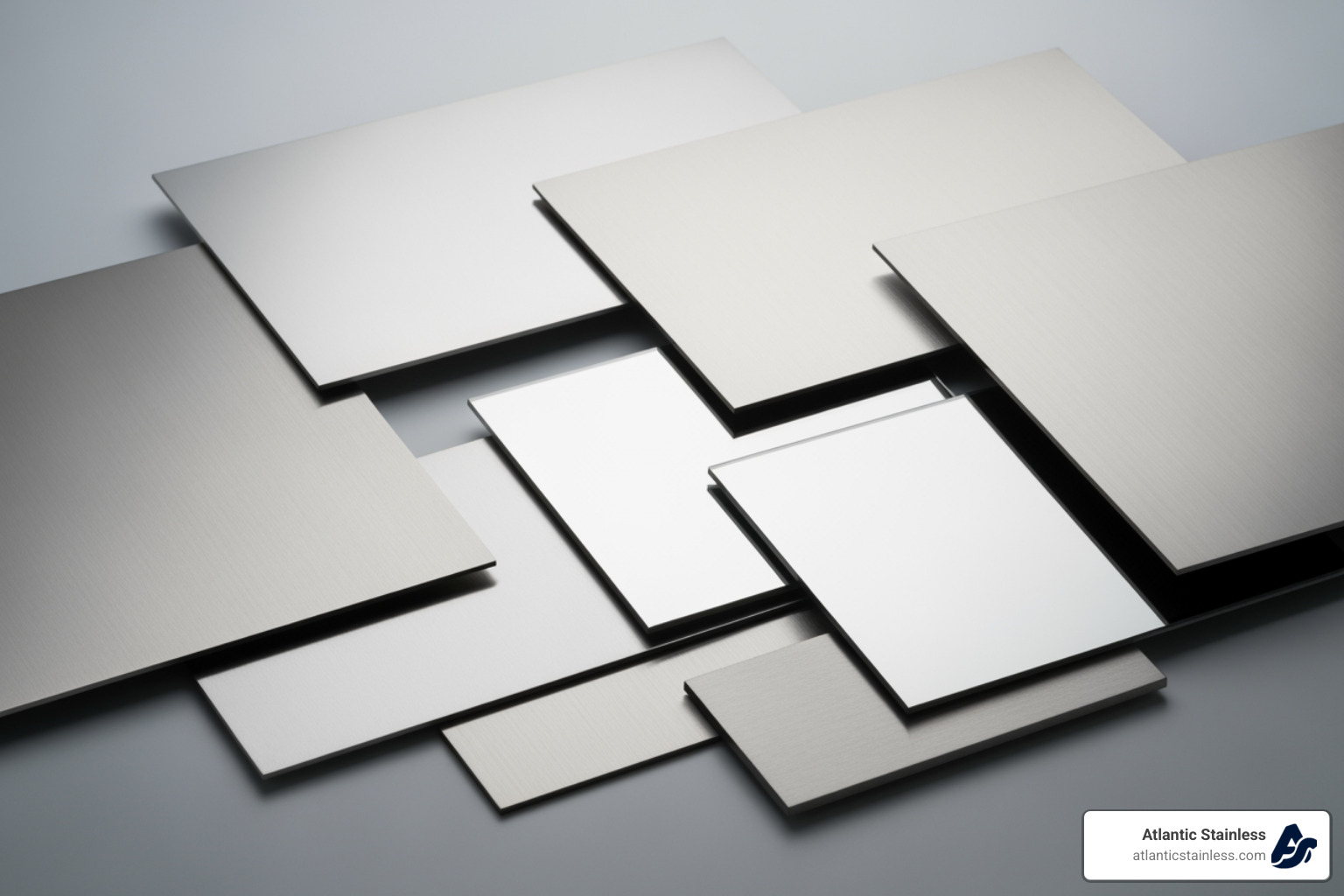
- 2B Mill Finish: This is a common cold-rolled, annealed, pickled, and skin-passed finish. It’s a smooth, dull, and somewhat reflective matte finish. While it might look good initially, it can be prone to showing fingerprints, oils, and liquids, leading to uneven coloring in applications where it’s frequently handled or cleaned. It’s often used for industrial applications where a smooth, easily cleanable surface is needed but high aesthetic appeal isn’t the primary concern.
- 2D Finish: Similar to 2B, this is also a dull finish achieved through cold rolling, annealing, and pickling, often with dull blasted rolls. It has a less reflective, rougher appearance than 2B and is typically used for applications where deep drawing or forming is required.
- #4 Brushed Finish: This is arguably the most popular and recognizable finish, often considered the industry standard for commercial, industrial, and residential applications where aesthetics and longevity are important. It’s characterized by fine, uniform, directional polishing lines (typically 180 grit). This brushed finish is consistent, easy to match, and excellent for kitchen appliances, architectural panels, and food service equipment. It will never fade and is basically ageless, provided it’s properly maintained. For more on achieving this look, explore A Guide to Polishing Stainless Steel.
- #8 Mirror Finish: This is a highly reflective, non-directional finish that resembles a mirror. It’s achieved through extensive polishing and buffing. The #8 mirror finish is primarily used for decorative applications, signage, and architectural features where a premium, high-gloss appearance is desired. Because of its reflective nature, it requires careful handling and installation to prevent distortion or damage. For a broader understanding of polished finishes, you might find our insights on Polishing helpful.
Typical Dimensions of Rolled Stainless Steel Sheet
When ordering rolled stainless steel sheet, understanding the typical dimensions available is crucial for project planning and cost efficiency. The dimensions generally refer to thickness, width, and length.
- Thickness: This is often measured in inches or by gauge number. For stainless steel rolls and sheets, thicknesses can range from as thin as .010” to .032”. For cold-rolled sheets, specific finishes dictate ranges: BA finish sheets typically range from 0.012 – 0.062 inches, while 2B/2D finishes can range from 0.017 – 0.250 inches. Thicker material, usually above 7 gauge (or 3/16 inch), is typically classified as plate rather than sheet.
- Width: Standard widths are commonly available, with 36.0, 48.0, and 60.0 inches being prevalent. However, some cold-rolled coils can be supplied in widths up to 72 inches.
- Length: Standard lengths often include 96.0, 120.0, and 144.0 inches, with 120.0 inches (10 feet) being a very common choice. We also see lengths of 6 ft, 8 ft, 10 ft, 12 ft, and 50 ft for stainless steel rolls.
For most projects, standard sheet sizes like 36″ x 120″, 48″ x 120″, and 60″ x 120″ are readily available. These sizes are efficient for many manufacturing processes. For more on common sizes, check out our article on Standard Size Stainless Steel Sheets. However, custom sizes are also possible, offering flexibility for unique applications.
Primary Uses and Applications of Rolled Stainless Steel Sheets
Rolled stainless steel sheet is a true workhorse, finding its way into countless applications across diverse industries. Its versatility, combined with inherent durability and aesthetic appeal, makes it an indispensable material. From the gleaming surfaces of a commercial kitchen to robust industrial tanks and neat architectural cladding, its uses are widespread.
Industrial and Commercial Applications
We see rolled stainless steel sheet used in a vast array of industrial and commercial settings:
- Food Processing and Commercial Kitchens: This is a prime example where hygiene is paramount. Type 304 stainless steel is the go-to for most food contact surfaces, equipment, and wall coverings due to its ease of cleaning and corrosion resistance. For environments with high salt or chloride exposure, such as canning facilities, Type 316 stainless steel is preferred for its superior resistance. To understand why, read our guide on What is Food Grade Stainless Steel? Guide to SS304.
- Chemical & Pharmaceutical: Highly corrosive environments in these industries demand the improved resistance of grades like Type 316, especially its low-carbon variant, 316L, which minimizes sensitization during welding. This is crucial for tanks, pressure vessels, and piping.
- Medical & Healthcare: From surgical instruments to hospital equipment and fixtures, stainless steel’s ability to be frequently cleaned and sterilized without degradation is invaluable.
- Automotive: Used in components like exhaust systems, trim, grills, and structural parts where durability and corrosion resistance are key.
- Architecture & Construction: For both interior and exterior applications, it serves as cladding, roofing, wall panels, elevator interiors, and handrails, offering a modern aesthetic and long lifespan.
- Energy & Power Generation: Components for renewable energy systems, including solar panels, wind turbines, and hydroelectric power plants, benefit from stainless steel’s strength and resistance to environmental factors.
Insulation Protection and Jacketing
One specific, yet critical, application for rolled stainless steel sheet is in insulation protection and jacketing. Our stainless steel rolls and sheets are specifically designed to protect underlying insulation from various external damages.
The benefits of using stainless steel for insulation protection, often referred to as jacketing, are numerous:
- Weather Protection: It acts as a durable barrier against rain, snow, and wind, preventing moisture ingress into the insulation.
- UV Resistance: Stainless steel effectively blocks harmful ultraviolet light, which can degrade certain insulation materials over time.
- Water Damage Prevention: Its corrosion resistance ensures that splashes, leaks, or condensation do not compromise the integrity of the insulation.
- Mechanical Protection: It provides a robust shield against physical damage, such as impacts, abrasions, and general wear and tear, which is common in industrial settings.
- Hygiene and Cleanliness: The non-porous surface is easy to clean, preventing the accumulation of dirt, mold, or bacteria, which is particularly important in food processing or pharmaceutical facilities.
- Fire Resistance: Stainless steel is non-combustible, offering an additional layer of fire safety.
- Aesthetics: It provides a clean, professional appearance to insulated pipes, tanks, and vessels.
These rolls and sheets are commonly used for pipe covering and tank insulation in a variety of industrial environments. Typical thicknesses available for this application range from .010” to .032”, and finishes can include smooth, stucco embossed (for added rigidity and reduced glare), or corrugated (for larger diameters and structural integrity).
Working with and Customizing Stainless Steel Sheets
Working with rolled stainless steel sheet often involves fabrication processes like cutting, forming, and welding. While stainless steel offers incredible advantages, there are special considerations and limitations that we always advise our clients to be aware of. The right supplier can offer a range of services to help you steer these complexities; learn more in our article 5 Services a Stainless Steel Supplier Can Offer.
Key Considerations: Work Hardening and Magnetism
Two important properties to keep in mind when working with rolled stainless steel sheet are work hardening and magnetic properties.
- Work Hardening: Austenitic stainless steel grades, such as the 300 series (including 304 and 316), are known for their excellent ductility but also their tendency to work harden rapidly. This means that as the material is plastically deformed (bent, stretched, or machined), it becomes stronger and harder. While this can be a beneficial property for certain applications, it can also present challenges during fabrication. Machining these grades, for instance, requires specific tools and techniques to prevent excessive tool wear and ensure a clean cut. Forming operations may also require intermediate annealing steps to restore ductility if severe deformation is needed.
- Magnetic Properties: The magnetic properties of stainless steel vary significantly by grade. Ferritic stainless steels (like 430) are inherently magnetic due due to their crystal structure. Austenitic stainless steels (like 304 and 316), however, are generally non-magnetic in their annealed state. This non-magnetic characteristic is often desirable for sensitive electronic equipment or medical devices. However, it’s important to note that even non-magnetic 300 series stainless steel may become slightly magnetic when heavily cold worked or formed. This is due to the formation of martensite in the microstructure during deformation.
The Advantages of Custom-Cut Sheets
While standard sizes for rolled stainless steel sheet are widely available and cost-effective for many projects, there are significant advantages to opting for custom-cut sheets.
- Reduced Waste: Purchasing material cut to your exact specifications minimizes scrap, leading to cost savings on material and waste disposal. No need to buy full lengths when you only need a portion!
- Cost Savings: Beyond material waste, custom cuts can reduce labor costs associated with in-house cutting and processing, as well as the time spent on these tasks.
- Project Efficiency: Receiving material that is ready to use streamlines your fabrication process, reducing lead times and accelerating project completion.
- Precision Cutting: Advanced cutting technologies ensure high accuracy and clean edges, which are critical for precision assemblies and aesthetic applications. We use various cutting services, including Waterjet Cutting, which offers exceptional precision for intricate shapes. Our Shearing services are perfect for straight-line cuts on thinner gauges, and our Saw Cutting capabilities handle thicker material with ease.
Choosing custom-cut sheets means we can deliver exactly what you need, making your project smoother and more efficient.
Conclusion
The world of rolled stainless steel sheet is vast and varied, shaped fundamentally by whether the material undergoes hot or cold rolling. We’ve explored how these processes dictate everything from surface finish and dimensional accuracy to strength and ductility. Understanding the differences between hot-rolled sheets, with their cost-effectiveness and good formability for structural uses, and cold-rolled sheets, prized for their superior aesthetics and tighter tolerances in applications like appliances, is key to successful material selection.
We’ve also digd into the crucial role of different stainless steel grades, highlighting the widespread versatility of Type 304 and the improved corrosion resistance of Type 316, especially in challenging environments. The spectrum of available finishes, from the utilitarian 2B to the neat #4 brushed and mirror-like #8, further expands the possibilities, allowing for precise matching to functional and aesthetic requirements. Finally, grasping the typical dimensions and the benefits of custom-cut sheets ensures that your project not only gets the right material but also optimizes efficiency and minimizes waste.
At Atlantic Stainless, we pride ourselves on being a nationwide supplier and processor of high-quality stainless steel and high-temperature alloys. With our extensive inventory, prompt delivery, and best service, we’re here to help you steer these choices. We invite you to explore our extensive inventory of stainless steel sheet and plate to find the perfect material for your next masterpiece.