The A to Z of Stainless Steel Grades: What You Need to Know
Why Understanding Stainless Steel Grades Matters for Your Project
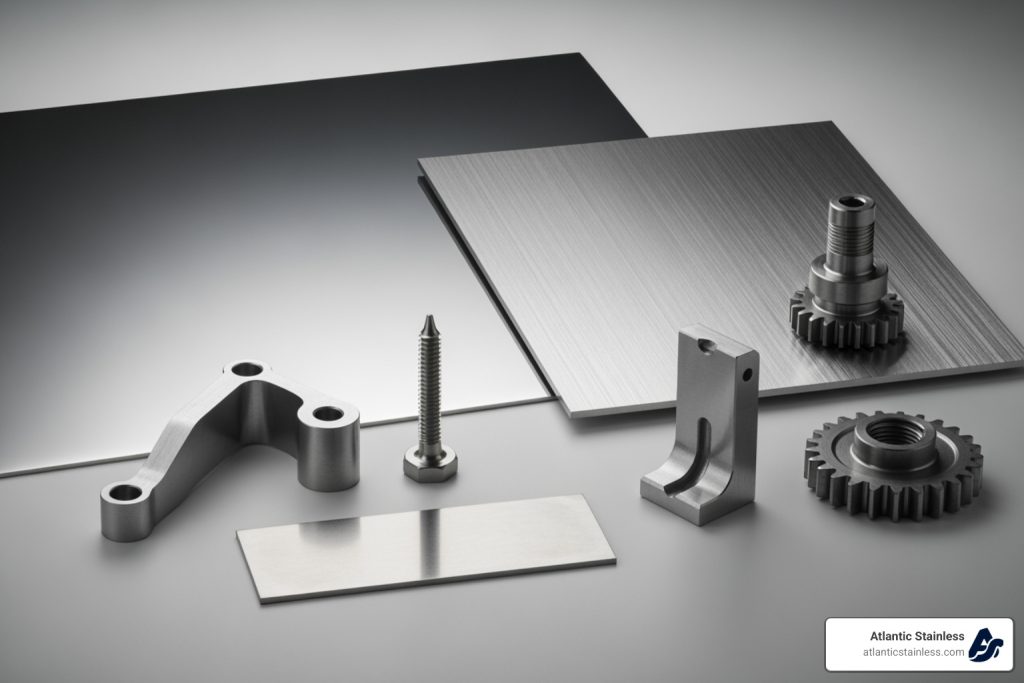
Understanding stainless steel grades is essential for selecting the right material for your project. With over 150 different grades available, each designed for specific applications, choosing the wrong one can lead to premature failure, unnecessary costs, or compromised performance.
Quick Answer: The Five Main Families of Stainless Steel Grades
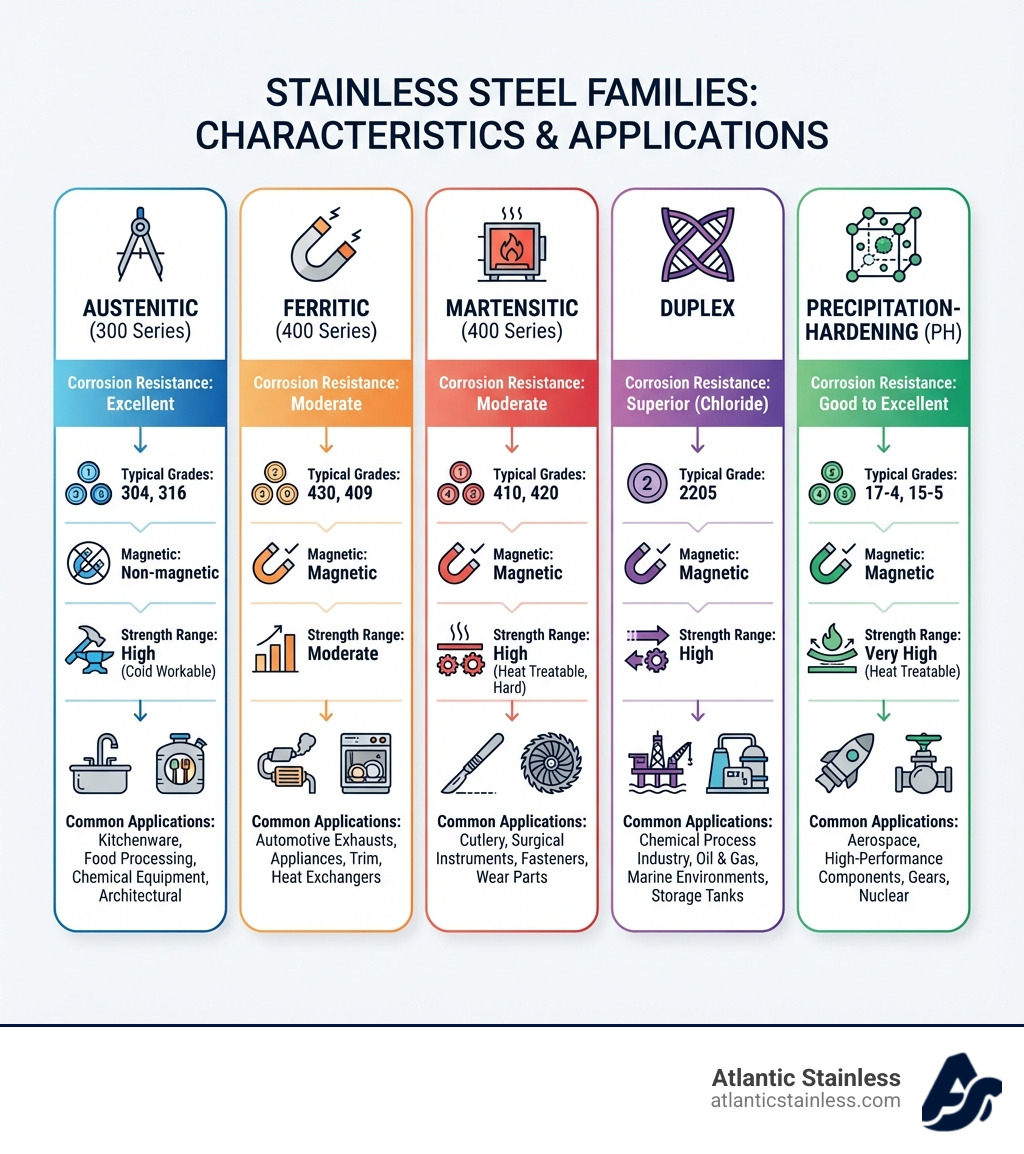
- Austenitic (300 Series) – Most common, non-magnetic, excellent corrosion resistance (e.g., 304, 316)
- Ferritic (400 Series) – Magnetic, cost-effective, moderate corrosion resistance (e.g., 430, 409)
- Martensitic (400 Series) – High strength and hardness, heat treatable (e.g., 410, 420)
- Duplex – Combined austenite-ferrite structure, high strength, excellent corrosion resistance (e.g., 2205)
- Precipitation-Hardening (PH) – Very high strength, heat treatable (e.g., 17-4, 15-5)
Stainless steel is a family of corrosion-resistant steels containing a minimum of 10.5% chromium. This element forms a protective oxide layer that makes the steel “stainless,” but the specific grade determines everything from corrosion resistance and strength to cost and fabrication ease. For example, grade 304 alone represents 50% of all stainless steel produced globally.
The classification system divides stainless steel into families based on their crystalline structure. Within each family, specific grades offer different properties. For instance, adding molybdenum to grade 304 creates grade 316, which provides superior resistance to chlorides and harsh environments.
This guide will help you steer stainless steel grades to make informed decisions. You’ll learn what makes each family unique, how to compare common grades like 304 vs. 316, and which factors matter most when selecting a grade for your application.
What is Stainless Steel? The Basics Explained
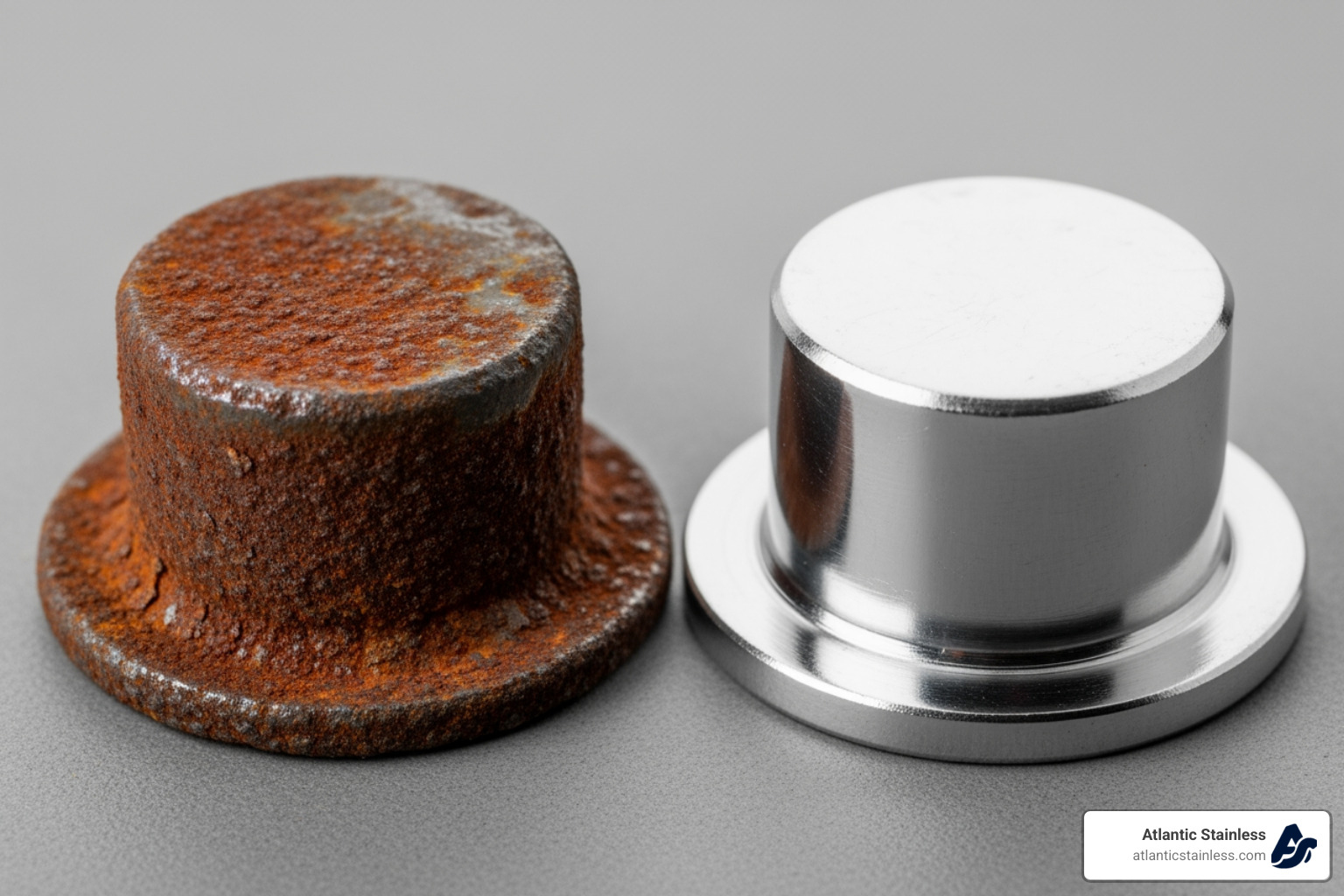
Steel, an alloy of iron and carbon, is strong but prone to rust (iron oxide) when exposed to moisture. Stainless steel solves this problem. It’s a family of iron-based alloys containing a minimum of 10.5% chromium, which provides incredible corrosion resistance.
The Defining Element: How Chromium Creates “Stainless” Steel
The secret to stainless steel’s durability is chromium. At a minimum of 10.5%, chromium reacts with oxygen to form a thin, invisible, protective layer of chromium oxide on the surface, a process called “passivation.”
This “passive” layer shields the iron from oxygen, preventing rust. Amazingly, this layer is self-healing; if scratched, the exposed chromium quickly reforms the protective oxide layer, ensuring continuous corrosion resistance. This fundamental difference makes stainless steel a long-lasting, low-maintenance material compared to regular steel. For a deeper dive, explore our guide on Stainless Steel vs Galvanized Steel.
Decoding the Numbers: An Overview of Grading Systems
Various organizations have developed systems to classify and standardize stainless steel, ensuring consistency.
- The American Iron and Steel Institute (AISI) created the three-digit system (e.g., 304, 316) that is still widely used in the industry, though no longer officially maintained.
- The SAE (Society of Automotive Engineers) system also uses a three-digit designation that aligns closely with AISI numbers. You can learn more at their website: http://www.sae.org/.
- The ASTM (American Society for Testing and Materials) system uses the Unified Numbering System (UNS), a six-character identifier (e.g., S30400 for 304 stainless). The ‘S’ denotes stainless steel, and the first three digits often match the AISI grade. More information is available at https://www.astm.org/index.html.
These systems, along with international standards (EN, JIS, ISO), provide a universal language for specifying stainless steel grades.
The Five Families of Stainless Steel
Stainless steel is categorized into five families based on its crystalline structure (microstructure), which dictates properties like magnetism, strength, and corrosion resistance. Each family is suited for different applications. The five main families are:
- Austenitic
- Ferritic
- Martensitic
- Duplex
- Precipitation-Hardening (PH)
Austenitic (300 Series): The Most Common Family
Austenitic grades are the most widely used, accounting for over 50% of global stainless steel production. Alloying elements like nickel, manganese, and nitrogen create their unique crystal structure, providing a fantastic combination of properties:
- Non-magnetic: Generally non-magnetic when annealed.
- Excellent Formability and Weldability: Highly ductile and easy to shape, form, and weld.
- Superior Corrosion Resistance: High chromium and nickel content provide excellent corrosion resistance.
- Exceptional Toughness: Maintain toughness even at cryogenic temperatures.
The most common grades are Grade 304 and Grade 316. Grade 304 (“18/8” stainless) is a versatile workhorse used in kitchen sinks, appliances, and architecture. It alone represents 50% of all stainless steel produced. Learn more on our 304 Stainless Steel page.
Grade 316 adds molybdenum to 304, dramatically boosting resistance to chlorides and harsh environments, making it ideal for marine and chemical applications. Find out more on our 316 Stainless Steel page.

Low-carbon variants like 304L and 316L (with <0.03% carbon) prevent carbide precipitation during welding, which can cause corrosion. This makes them ideal for welded components where corrosion resistance is critical. Explore our pages for 304L and 316L.
Typical applications include:
- Kitchenware and food processing equipment
- Architectural roofing and cladding
- Chemical tanks and piping
- Medical devices
Ferritic (400 Series): The Cost-Effective Choice
Ferritic stainless steels contain little to no nickel, making them a more affordable, magnetic option.
- Magnetic Properties: Unlike austenitic grades, ferritic grades are magnetic.
- Moderate Corrosion Resistance: They provide good resistance, especially to chloride stress corrosion cracking.
- Good Ductility: They are reasonably ductile and formable.
- Cost-Effectiveness: Their lower nickel content means a lower, more stable price.
Common grades are Grade 430, used for automotive trim and appliances, and Grade 409, often found in automotive exhaust systems. For more information, check out our Guide to Ferritic Stainless Steel Grades.
Martensitic (400 Series): The Hard & Strong Family
For applications requiring high strength and hardness, the martensitic family is the solution. These grades can be heat-treated to achieve impressive hardness and wear resistance.
- High Strength and Hardness: High carbon content allows them to be hardened and tempered.
- Wear Resistance: High hardness provides excellent wear resistance for cutting applications.
- Magnetic Properties: Martensitic grades are magnetic.
- Moderate Corrosion Resistance: Corrosion resistance is good but generally not as high as austenitic grades.
Common grades include Grade 410 (for fasteners and valves) and Grade 420 (“blade grade steel” for cutlery and surgical instruments). To learn more, visit our page on What You Need to Know About 400 Series Stainless Steel.
Duplex: The Best of Both Worlds
Duplex stainless steels combine the best features of austenitic and ferritic steels. Their mixed microstructure, a near 50/50 blend of austenite and ferrite, results in an outstanding set of properties:
- High Tensile Strength: Significantly stronger than austenitic or ferritic grades.
- Excellent Corrosion Resistance: Superior resistance to pitting and stress corrosion cracking.
- Good Weldability and Formability: Offer good fabrication characteristics.
- Weakly Magnetic: Their mixed structure makes them weakly magnetic.
Grade 2205 Stainless Steel is a widely used duplex grade, ideal for demanding environments like marine, oil and gas, and chemical processing. Explore its capabilities on our 2205 Stainless Steel page.
Precipitation-Hardening (PH): The High-Strength Specialists
For the highest strength applications, precipitation-hardening (PH) stainless steels are the choice. These alloys gain their strength from a heat treatment process called “ageing.”
- Very High Strength: Can achieve tensile strengths up to four times that of standard austenitic alloys.
- Moderate to Good Corrosion Resistance: A good balance of strength and corrosion resistance.
- Heat Treatable: Properties are controlled through low-temperature ageing.
- Magnetic Properties: PH alloys are magnetic.
Common grades include 17-4 Stainless Steel and 15-5 Stainless Steel, which are frequently used in aerospace, nuclear, and medical applications. Learn more on our 17-4 Stainless Steel and 15-5 Stainless Steel pages.
Grade vs. Grade: A Practical Comparison
Choosing the right stainless steel often comes down to a direct comparison between specific options. The table below shows how common grades stack up in key areas.
| Property | 304 Stainless Steel | 316 Stainless Steel | 430 Stainless Steel |
|---|---|---|---|
| Corrosion Resistance | Excellent (general, fresh water, food) | Superior (especially against chlorides, saltwater) | Good (moderate, indoor, mild environments) |
| Cost | Moderate (benchmark) | Higher (due to molybdenum) | Lower (due to no nickel) |
| Strength | Good (high tensile, work hardenable) | Very Good (slightly higher tensile, especially at temp) | Moderate (good tensile, not heat treatable for strength) |
| Magnetism | Non-magnetic (when annealed, can become slightly magnetic with cold work) | Non-magnetic | Magnetic |
| Applications | Kitchenware, appliances, food processing, architectural, general industrial | Marine, chemical processing, medical, coastal, cleanroom | Automotive trim, appliances, decorative, indoor |
304 vs. 316: The Role of Molybdenum
The comparison between 304 and 316 is one of the most common in the industry. Both are austenitic, but one key element separates them: molybdenum.
- Molybdenum’s Impact: Grade 316 contains 2-3% molybdenum, which significantly boosts its resistance to corrosion, especially pitting from chlorides found in saltwater or de-icing salts.
- When to Choose 316: For applications in marine environments, chemical processing, or areas with high salinity, 316 is the superior choice for longevity and reliability.
- Cost: The addition of molybdenum makes 316 more expensive than 304. For applications with minimal chloride exposure, 304 provides excellent value.
- Other Differences: Grade 316 is slightly stronger than 304, particularly at liftd temperatures, but can be more difficult to machine.
The choice boils down to environment versus cost. The investment in 316 is worthwhile for harsh conditions. For more details, see our article on Differences 316 Straight Grade and 316L Stainless Steel.
304 vs. 430: Austenitic vs. Ferritic
This comparison highlights the differences between austenitic (304) and ferritic (430) grades.
- Corrosion Resistance: Grade 304 has superior corrosion resistance due to its nickel content, making it suitable for outdoor and corrosive applications where 430 would not be recommended.
- Magnetic Properties: Grade 304 is non-magnetic, while Grade 430 is magnetic. This is often a key deciding factor.
- Formability and Weldability: Grade 304 is easier to form and weld than Grade 430.
- Cost-Effectiveness: Grade 430 is significantly cheaper because it contains no nickel. This makes it a great choice for budget-conscious projects in mild environments, like indoor trim or appliances.
The choice depends on balancing budget with performance. For demanding applications, 304 is superior; for less harsh environments where cost is key, 430 is an economical option. For more insights, read our article on Comparing Popular Steel Grades.
A Guide to Understanding Stainless Steel Grades for Your Application
Choosing the right stainless steel involves balancing performance, cost, and practicality for your project.
Key Factors in Your Selection Process
When selecting a stainless steel grade, consider these critical factors to ensure a long, cost-effective product life:
- Corrosion Environment: Consider exposure to moisture, chemicals, salts, and acids. The environment dictates the required corrosion resistance. For instance, chloride exposure often requires a grade like 316 over 304.
- Mechanical Strength: What loads will the material bear? Consider yield strength, tensile strength, and fatigue strength. Martensitic and duplex grades offer higher strength than standard austenitic grades.
- Ductility and Hardness: Will the material be formed or shaped? Ductile austenitic steels are easy to form, while hard martensitic or PH grades are better for wear resistance.
- Operating Temperature: Will the steel face extreme heat or cold? Austenitic grades excel at cryogenic temperatures, while high-temperature grades (like 310) are designed for service up to 2100°F.
- Fabrication Needs: How will the steel be processed? Consider formability, weldability, and machinability. Austenitic grades are generally easy to weld, while others can be more challenging.
Considering these factors upfront helps avoid costly mistakes. For a comprehensive guide, refer to our Stainless Steel Material Selection Guide.
The Impact of Finishing and Processing
The finish and processing of stainless steel can significantly alter its properties.
- Heat Treatment: This process modifies mechanical properties. Annealing softens the steel, improving ductility for forming and welding. Hardening (via heat treatment for martensitic/PH grades or cold working for austenitic grades) dramatically increases strength.
- Surface Finish: A smooth, polished surface improves corrosion resistance and hygiene. Processes like Polishing for aesthetics and hygiene create a cleaner, more passive surface. Electropolishing provides an ultra-smooth finish ideal for medical and hygienic applications.
- Fabrication Services: Our precision fabrication, including Waterjet cutting and Plasma cutting, ensures your material is processed to exact specifications without compromising its properties.
Frequently Asked Questions about Understanding Stainless Steel Grades
We often receive questions from our clients who are trying to make sense of the many options available. Here are some of the most common inquiries we address when discussing Understanding stainless steel grades:
What is the most common stainless steel grade?
Without a doubt, Grade 304 is the most common stainless steel grade. It’s so prevalent that it accounts for more than 50% of the global production of stainless steel. You’ll often hear it referred to as “18/8 stainless steel,” which signifies its approximate composition of 18% chromium and 8% nickel.
Its popularity stems from an excellent balance of properties: impressive corrosion resistance in a wide range of environments, good formability and weldability, and a relatively moderate cost. This versatility makes it the go-to choice for countless applications, from kitchen appliances and food processing equipment to architectural components and general industrial use. If you’re looking for stainless steel that’s suitable for food contact, 304 is usually the answer. Learn more about its role in the food industry on our page: What is Food Grade Stainless Steel? A Guide to SS304.
Is all stainless steel non-magnetic?
That’s a common misconception, and the answer is a resounding no! Whether stainless steel is magnetic or not depends entirely on its crystalline structure, which is determined by its specific alloying elements.
- Austenitic grades (like 304 and 316) are generally non-magnetic when they are in their annealed (softened) state. This is due to their face-centered cubic crystal structure. However, it’s worth noting that cold working (processes like bending, forming, or rolling) can sometimes induce a limited degree of magnetism in some austenitic grades.
- Ferritic, Martensitic, and Duplex grades, on the other hand, are all magnetic. Ferritic and martensitic steels have a body-centered cubic or tetragonal structure, respectively, which makes them ferromagnetic. Duplex steels, with their mixed austenitic and ferritic structure, will also exhibit magnetic properties, though their strength of magnetism can vary.
So, if magnetism is a critical factor for your application, specify the correct stainless steel family and grade.
What does the “L” mean in grades like 304L and 316L?
The “L” in grades such as 304L and 316L stands for “Low Carbon.” This designation indicates that these specific variants have a reduced carbon content compared to their standard counterparts (304 and 316). Typically, the carbon content in “L” grades is kept below 0.03%.
This low carbon level offers a significant benefit, especially in applications involving welding. Standard stainless steels, when heated during welding, can sometimes experience “sensitization,” where chromium carbides form at the grain boundaries. This depletes the surrounding material of chromium, making it susceptible to intergranular corrosion, particularly in harsh environments.
By minimizing the carbon content, 304L and 316L effectively prevent carbide precipitation during welding. This means they retain their full corrosion resistance in the heat-affected zone, significantly improving weldability and ensuring the integrity of the welded structure. For projects requiring extensive welding or those destined for corrosive environments, selecting an “L” grade is a smart choice to maintain long-term performance and prevent premature failure.
Conclusion: Making the Right Choice
As we’ve explored, Understanding stainless steel grades is far more than just memorizing numbers. It’s about recognizing that each grade is a carefully engineered solution, designed with a specific balance of properties to excel in particular applications. From the everyday versatility of austenitic 304 to the extreme strength of precipitation-hardening alloys, the perfect stainless steel is out there for every challenge.
Our goal is always to help you match the right material to your project, ensuring optimal performance, longevity, and cost-effectiveness. By considering factors like the operating environment, required strength, formability, and processing needs, you can make an informed decision that saves time, money, and headaches down the road.
At Atlantic Stainless, we pride ourselves on being your trusted partner in this journey. With our extensive inventory of high-quality stainless steel and high-temperature alloys, coupled with our deep industry experience, we’re here to provide the materials and expertise you need.
For a complete overview of our offerings, explore our main Stainless Steel Grades page.