Beyond the Blade: Exploring Pressurized Water Cutting for Metal Fabrication
What You Need to Know About Pressurized Water Cutting Metal
Last updated on May 28th, 2026 at 01:38 pm
Pressurized water cutting metal uses an ultra-high-pressure stream of water—often mixed with abrasive particles—to slice through virtually any conductive material without generating heat. Here’s what makes this technology essential for modern metal fabrication:
Quick Answer: How It Works
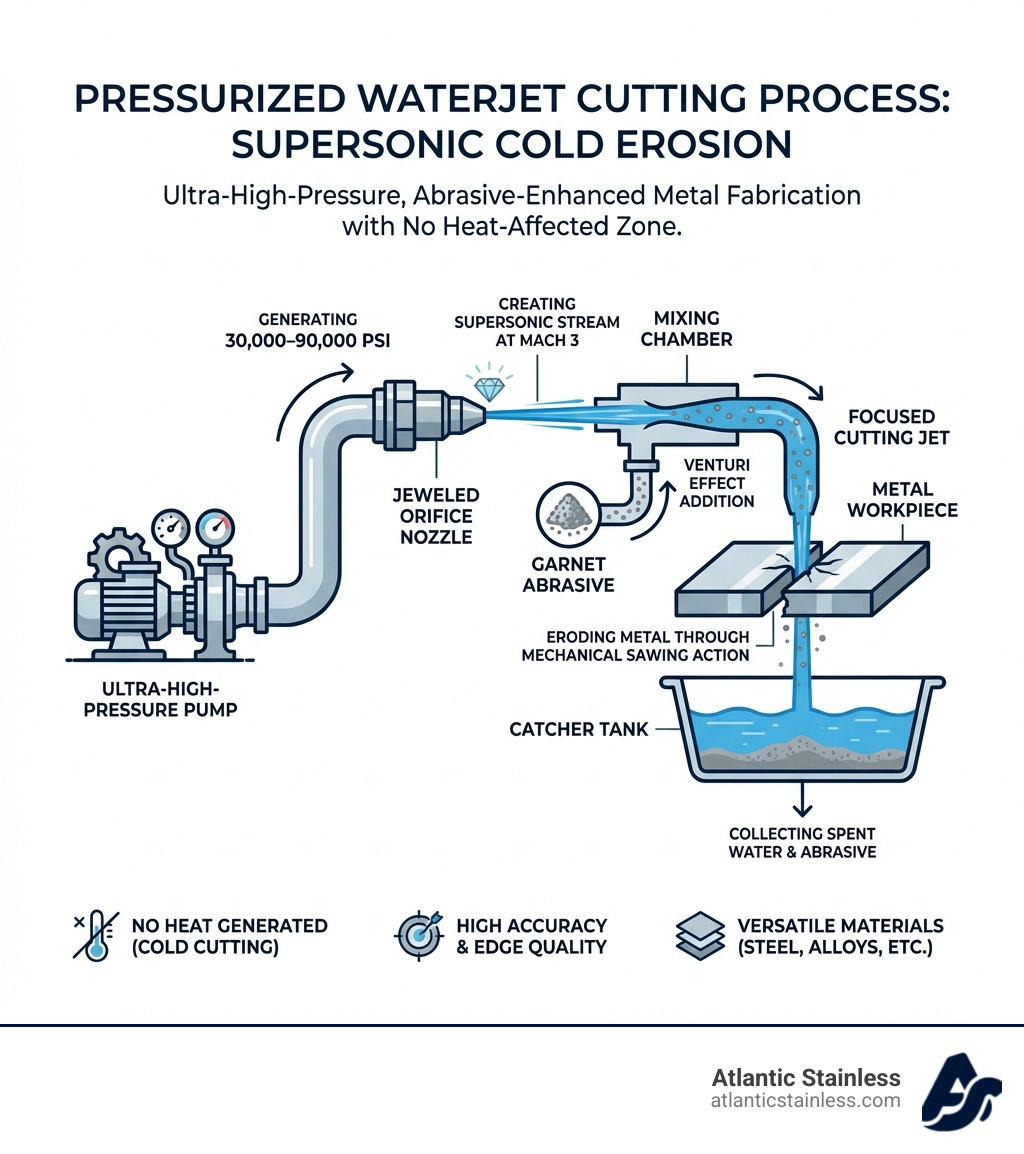
- Water is pressurized to 30,000–90,000 PSI (up to 620 MPa)
- The stream exits a jeweled nozzle at approximately Mach 3 (around 2,500 ft/s)
- For hard metals, garnet abrasive is added to the stream
- The jet erodes material through mechanical sawing action
- No heat is generated, preserving material properties
Key Capabilities
- Thickness range: Up to 6–9 inches of steel (some systems handle more)
- Accuracy: Down to ±0.005 inches (0.13 mm)
- Materials: Steel, stainless steel, aluminum, titanium, copper, hardened alloys
- Edge quality: Clean cuts with minimal burr, often no secondary finishing needed
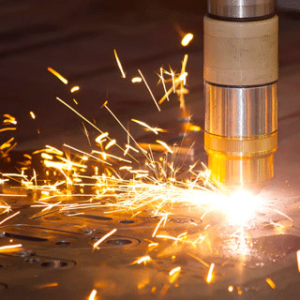
If you’ve ever watched sparks fly during plasma cutting or worried about heat distortion when laser-cutting thick stainless steel, waterjet technology offers a compelling alternative. The process is fundamentally different: instead of melting metal with intense heat, pressurized water cutting uses controlled erosion to remove material cold.
This matters enormously for metal fabricators working with heat-sensitive alloys, thick sections, or applications where preserving the material’s inherent structure is critical. There’s no heat-affected zone (HAZ), no thermal distortion, and no change to the metal’s molecular properties.
The technology has evolved significantly since its origins in the 1970s. What started as experiments in rock cutting has become a sophisticated, CNC-controlled process capable of producing aerospace components, architectural features, and precision medical devices. Modern systems combine computing power with ultra-high-pressure pumps to compensate for jet dynamics and achieve tolerances that rival traditional machining.
For fabricators sourcing stainless steel plate, high-temperature alloys, or specialized materials, understanding waterjet cutting opens new possibilities for complex geometries, rapid prototyping, and efficient production—all while maintaining the integrity of premium metals.
How Pressurized Water Cutting Metal Works: The Science of Supersonic Erosion
At its heart, pressurized water cutting metal is a marvel of engineering that harnesses the power of water to perform tasks once thought impossible. Imagine turning ordinary tap water into a tool capable of slicing through steel! That’s precisely what high-pressure water jet cutting achieves.
The process begins by filtering ordinary tap water, ensuring its purity to protect the sensitive components of the system. This clean water is then fed into a specialized pump, which is the muscle behind the operation. These pumps are designed to generate immense pressure, typically ranging between 20,000 psi and 55,000 psi for cutting steel, with ultra-high-pressure systems capable of reaching up to 100,000 psi (690 MPa).
Once pressurized, this ultra-high-pressure water is forced through a tiny jewel orifice, usually made of durable materials like ruby or diamond, measuring only about 0.010–0.015 inch in diameter. As the water exits this orifice, all that stored pressure is converted into incredible velocity. The water jet stream is ejected at speeds on the order of Mach 3, around 2,500 ft/s (760 m/s), or up to 2 or 3 times the speed of sound! This supersonic stream is what gives the water its cutting power.
For an in-depth look at this fascinating technology, you might find our Guide to Waterjet Cutting helpful.
The Core Components of a Waterjet System
A complete waterjet cutting system is a sophisticated setup of interconnected components working in harmony:
- High-pressure Pump: This is the heart of the system, responsible for pressurizing the water. There are two primary types:
- Intensifier Pumps: These use hydraulic oil to power a piston, which in turn forces water through a tiny hole, intensifying the pressure. They have a higher initial cost but often boast lower long-term maintenance.
- Direct-Drive Pumps: These use a crankshaft to drive plungers that directly pressurize the water. They are simpler and less expensive initially but may require more frequent maintenance.
- CNC Controller: This is the brain, a computer numerical control system that precisely directs the cutting head’s movement, allowing for intricate designs and consistent results.
- Cutting Head: This assembly holds the jewel orifice and, for abrasive cutting, the mixing chamber.
- Nozzle (Jewel Orifice): The tiny opening (typically ruby or diamond) where water is converted from high pressure to high velocity.
- Mixing Tube (Focusing Tube): For abrasive waterjets, this is where the abrasive material is mixed with the high-velocity water. Typically made of tungsten carbide or ceramic composites like ROCTEC.
- Abrasive Delivery System: This feeds the abrasive material (usually garnet) into the mixing chamber.
- Catcher Tank: A large tank located beneath the cutting surface, designed to dissipate the energy of the spent water jet and collect the water and abrasive debris.
How Abrasive Waterjet Cutting Works
While a pure waterjet is effective for softer materials like rubber, foam, or paper, cutting hard materials like metal requires an extra punch. This is where abrasive waterjet cutting comes in.
In an abrasive waterjet system, after the high-pressure water stream exits the jewel orifice, it enters a mixing chamber. Here, a vacuum is created (thanks to the Venturi effect), which draws in granular abrasive material, most commonly garnet. The abrasive particles are then accelerated by the supersonic water stream, and this mixture is focused through a durable mixing tube.
The combined force of the water and the abrasive particles creates a highly energetic stream that cuts through materials through a process akin to mechanical sawing or accelerated erosion. It’s like having millions of tiny chisels striking the metal at supersonic speeds, gradually eroding a precise path. This method is incredibly effective for a wide range of metals and other hard substances.
The history of this remarkable technology dates back decades. Early patents for liquid blasting and cutting plastic masses emerged in the mid-20th century, but the true breakthrough for metal cutting came with the development of high-pressure pumps and the addition of abrasives. For more on this journey, explore A brief history of the technology.
The Best Advantages: Why Choose Waterjet Over Other Methods?
When it comes to metal fabrication, we’re constantly seeking methods that offer superior quality, efficiency, and material integrity. Pressurized water cutting metal stands out from other cutting technologies like laser or plasma cutting due to several key advantages that make it an invaluable tool in our arsenal.
The Critical Benefit of No Heat-Affected Zone (HAZ)
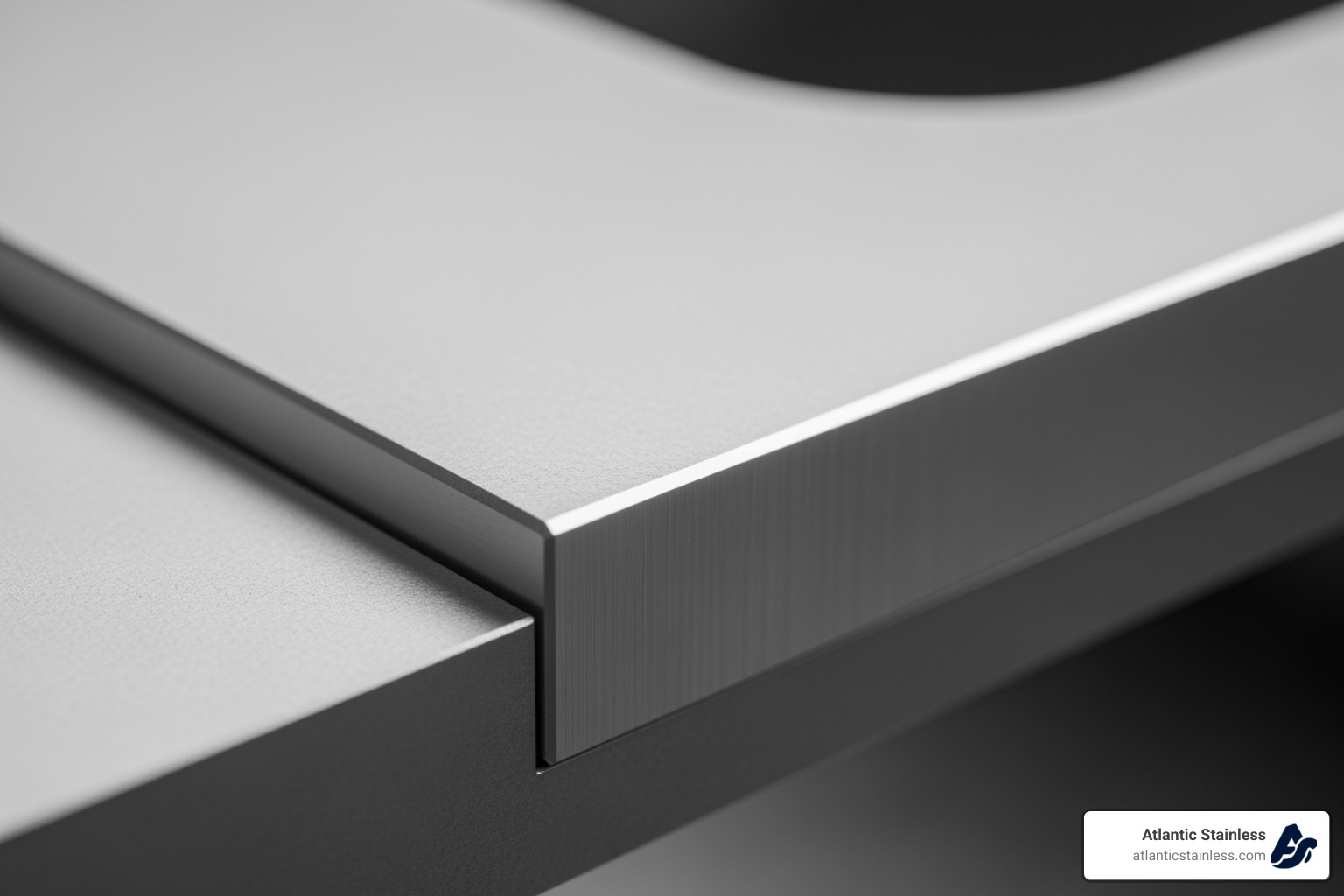
Perhaps the most significant advantage of waterjet cutting, especially for metals, is the complete absence of a Heat-Affected Zone (HAZ). Unlike thermal cutting methods such as laser, plasma, or oxy-fuel, which use heat to melt and vaporize material, waterjet cutting is a “cold cutting” process.
What does this mean for your metal parts?
- Preserving Material Properties: No HAZ means the material’s inherent properties—its strength, hardness, and metallurgical structure—remain unchanged. There’s no risk of thermal distortion, warping, or micro-cracking that can occur with heat-based processes.
- No Work Hardening: The cut edges don’t become hardened or brittle, which can be a problem with other methods. This makes subsequent operations like machining, welding, or bending much easier and more predictable.
- Ideal for Heat-Sensitive Alloys: For materials like stainless steel, titanium, and other high-temperature alloys, where maintaining specific metallurgical characteristics is paramount, waterjet cutting is often the preferred choice.
- Eliminating Secondary Finishing: Often, the clean, burr-free edge produced by waterjet cutting means no need for grinding, deburring, or other costly and time-consuming secondary finishing operations. This saves both time and money.
For a detailed comparison of these methods, check out our insights on Waterjet Cutting vs. Plasma Cutting: Which Method is Best? and Waterjet vs. Plasma Cutting: The Differences.
Precision, Accuracy, and Material Efficiency
Beyond the cold-cutting advantage, waterjet technology delivers exceptional precision and accuracy, leading to significant material efficiency and waste reduction.
- Best Accuracy: Water jets are capable of attaining accuracy down to 0.005 inches (0.13 mm) and repeatability down to 0.001 inches (0.025 mm). This level of precision is crucial for complex parts and tight tolerances required in demanding industries.
- Narrow Kerf Width: The kerf, or width of the cut, for abrasive waterjets typically ranges from 0.04 to 0.05 inches (1.0–1.3 mm), but can be as narrow as 0.02 inches (0.51 mm). This narrow kerf minimizes material removal, which is particularly beneficial when working with expensive metals. Pure waterjet cuts are even finer, normally 0.007 to 0.013 in (0.18–0.33 mm).
- Part Stacking: For thinner materials, we can stack multiple sheets and cut them simultaneously, dramatically increasing throughput and efficiency without compromising quality.
- Nesting Parts: Advanced CAD/CAM software allows for intricate nesting of parts on a single sheet of material, maximizing material utilization and minimizing scrap. This directly contributes to cost savings and reduced waste.
- Reduced Scrap Material: By combining narrow kerf with intelligent nesting, waterjet cutting significantly reduces the amount of wasted material, making it a highly sustainable and economical choice for our clients.
Material & Thickness Capabilities: Pushing the Limits of Fabrication
One of the most impressive aspects of pressurized water cutting metal is its incredible versatility. It’s often easier to list what a waterjet cannot cut than what it can! This technology allows us to work with an extraordinary range of materials and thicknesses, opening up possibilities for diverse projects.
What Types of Metals Can Be Cut?
The beauty of waterjet cutting lies in its ability to process virtually any type of metal, regardless of its hardness or reflectivity. This makes it an ideal solution for a multitude of applications across various industries.
We routinely cut:
- Steel: Mild steel, carbon steel, and hardened tool steel are all easily cut with abrasive waterjets.
- Stainless Steel: From common grades like 304 and 316 to more specialized stainless alloys, waterjet cutting maintains the integrity of this crucial material. We frequently process Stainless Steel Plate for our clients.
- Aluminum: Its reflectivity, which can be problematic for lasers, poses no challenge for waterjets.
- Titanium: A high-strength, lightweight metal critical for aerospace and medical applications, titanium is perfectly suited for waterjet cutting due to the absence of HAZ.
- Copper & Brass: These highly conductive and reflective metals are efficiently cut without issues.
- Bronze: Another versatile alloy that waterjet handles with ease.
- Exotic Alloys: High-temperature alloys, nickel alloys, and other specialty metals used in demanding environments are excellent candidates for waterjet cutting, as their unique properties are preserved.
- Other Metals: This includes gold, silver, tantalum, zinc, magnesium, tin, tungsten, and cast iron.
Beyond metals, waterjets can also cut composites, stone, glass, ceramics, plastics, rubber, wood, and even food! The only materials that are generally difficult or impossible to cut are diamonds (due to extreme hardness) and tempered glass (which shatters due to internal stresses).
Maximum Thickness for Pressurized Water Cutting Metal
The thickness capacity of pressurized water cutting metal systems is truly remarkable. While typical industrial machines can comfortably cut up to 6 inches of steel, commercially available machines can handle up to 9 inches. For specialized applications, some advanced systems can even cut 18-inch thick blocks of steel or 300 mm thick steel and titanium.
However, there’s often a trade-off between speed and thickness, as well as desired edge quality. Cutting thicker materials usually requires a slower cutting speed to ensure full penetration and maintain precision. The quality of the cut edge is often graded from Q1 (rough cut, faster speed) to Q5 or even Q9 (very fine cut, slower speed). For example, cutting 4 inches of aluminum at Q1 quality might be 4.2 in/min, while a Q5 quality cut would be slower at 0.72 in/min. We work with our clients to balance these factors to achieve the optimal result for their specific project.
Real-World Applications & Advanced Techniques
The precision, versatility, and cold-cutting nature of pressurized water cutting metal have made it indispensable across a vast array of industries. From intricate designs to robust structural components, this technology is shaping the future of fabrication.
Industrial Applications of Pressurized Water Cutting Metal
The unique advantages of waterjet cutting translate into critical benefits for many sectors:
- Aerospace: The absence of a HAZ is paramount for aerospace components, where material integrity is non-negotiable. Waterjets are used to fabricate turbine parts, structural components, brackets, and panels from titanium, aluminum, and high-temperature alloys.
- Automotive: From prototyping new designs to producing custom parts and intricate engine components, waterjet cutting offers the precision and flexibility needed in this industry. It allows for complex shapes without the risk of thermal distortion.
- Medical: The sterile, burr-free cuts and ability to process exotic alloys make waterjet ideal for manufacturing surgical instruments, implants, and other medical devices where hygiene and precision are critical.
- Art & Architecture: For intricate designs, custom signage, metal inlays, and sculptural elements, waterjet cutting provides artists and architects with the freedom to create complex patterns and forms in metal with unparalleled accuracy and finish.
- Raw Material Processing: We use waterjet technology to process raw steel, stainless steel, and other metals into smaller, manageable sheets and blocks for easier transportation and storage, or for further fabrication.
Expanding Possibilities with Multi-Axis Cutting
While traditional 2D waterjet cutting is incredibly powerful, advancements in multi-axis technology have pushed the boundaries even further.
- 5-Axis Cutting Heads: Modern waterjet systems often feature 5-axis cutting heads that can tilt and rotate. This allows for intricate 3D cuts, beveled edges, and complex geometries that would be impossible with a standard 3-axis machine.
- Taper Compensation: One common challenge in waterjet cutting, especially with thicker materials, is a slight taper in the cut edge. Multi-axis heads can dynamically adjust the angle of the jet during cutting to compensate for this taper, resulting in perfectly perpendicular edges. This significantly improves edge quality and reduces the need for secondary finishing.
- Creating Complex 3D Shapes: With multi-axis capabilities, we can fabricate parts with complex contours, angled holes, and intricate three-dimensional features, opening up new design possibilities for our clients.
- Bevel Cutting & Weld Preparation: The ability to cut precise bevels in one pass is a huge advantage for weld preparation. This ensures tight fits and strong welds, reducing fabrication time and improving overall product quality.
Frequently Asked Questions about Waterjet Cutting
We often hear common questions about pressurized water cutting metal. Here are some of the most frequent inquiries, along with our expert answers:
How fast can a waterjet cut metal?
The speed at which a waterjet can cut metal isn’t a single, fixed number; it’s a dynamic variable influenced by several factors:
- Material Type: Softer metals cut faster than harder ones. For example, aluminum will cut much faster than a hardened tool steel of the same thickness.
- Material Thickness: Thicker materials require more energy and a slower cutting speed to achieve a clean, full cut. For instance, cutting 0.5-inch titanium might be around 7 inches per minute with a 30 HP pump, but a 6-inch thick steel plate would be significantly slower.
- Water Pressure & Abrasive Flow: Higher pressures and optimal abrasive flow rates generally increase cutting speed.
- Desired Edge Quality: As mentioned earlier, a rougher, faster cut (Q1) will be significantly quicker than a very fine, precise cut (Q5 or Q9) on the same material. We work with you to determine the ideal balance between speed and quality for your project.
What are the main maintenance considerations for a waterjet?
Like any high-precision machinery, waterjet cutting systems require regular maintenance to ensure optimal performance and longevity. Key considerations include:
- Wear Parts: The components directly involved in the cutting process experience wear due to the extreme pressures and abrasive action. This includes the jewel orifices (nozzles), mixing tubes, and high-pressure seals within the pump. These parts need periodic inspection and replacement.
- Pump Maintenance: The high-pressure pump is the workhorse and requires routine servicing, including checking hydraulic fluid levels, filter changes, and inspecting internal components.
- Abrasive & Water Filtration Systems: Maintaining clean water and abrasive is crucial. Water filtration systems need regular cleaning or cartridge replacement, and abrasive hoppers should be kept free of moisture and contaminants.
- Overall System Checks: Regular calibration of the CNC system, inspection of cutting surfaces, and general cleanliness of the machine are also important to prevent issues and ensure consistent accuracy.
What are the environmental considerations of waterjet cutting?
Pressurized water cutting metal is considered one of the most environmentally friendly cutting technologies available, especially compared to thermal methods:
- No Hazardous Emissions: Unlike plasma or laser cutting, waterjet cutting produces no hazardous gases, fumes, or airborne dust particles. This creates a safer working environment and reduces air pollution.
- Water Recycling: The water used in the process can often be recycled in a closed-loop system, significantly reducing water consumption. Water jets typically use approximately 0.5 to 1 US gal (1.9–3.8 L) per minute, and much of this can be recovered and reused.
- Abrasive Disposal: The abrasive material, typically garnet, is a natural, inert, and non-toxic mineral. It can often be recycled for reuse or safely disposed of in a landfill.
- Reduced Waste: The high precision and material efficiency (narrow kerf, nesting capabilities) of waterjet cutting mean less scrap material, further contributing to a reduced environmental footprint.
Your Partner for Precision Metal Processing
Pressurized water cutting metal offers unparalleled versatility and precision, making it a cornerstone of modern metal fabrication. Its no-HAZ cutting preserves the integrity of materials like stainless steel and high-temperature alloys, ensuring that the components we produce meet the most stringent quality standards. This innovative technology enables us to bring complex designs to life and achieve highly efficient production for a diverse range of applications.
For projects requiring the highest quality materials and expert processing, we at Atlantic Stainless provide comprehensive solutions. With our extensive industry experience and commitment to best service, we’re ready to partner with you on your next fabrication challenge.
Explore our expert Waterjet Cutting services and find how we can help you achieve precision, efficiency, and superior quality in your metal fabrication needs.