Flat Out Fantastic: Where to Purchase Stainless Steel Flat Bar
Why Stainless Steel Flat Bar is Essential for Your Project
Last updated on May 28th, 2026 at 01:11 pm
When you need to buy stainless steel flat bar, you’re looking for a versatile, rectangular metal product that offers exceptional strength and corrosion resistance. Here’s what you need to know before making a purchase:
Quick Buying Guide:
- Grade 304: Most economical, ideal for general fabrication, frames, braces, and architectural trim
- Grade 316: Superior corrosion resistance for marine, food-grade, and chemical environments
- Sizes: Typically 1/8″ to 2″ thick, up to 8″ wide, in 12′ or 20′ lengths
- Finishes: Mill finish (standard), or polished/brushed for decorative/sanitary use
- Types: Sheared & edge-conditioned (cost-effective) or true flat bar (tighter tolerances)
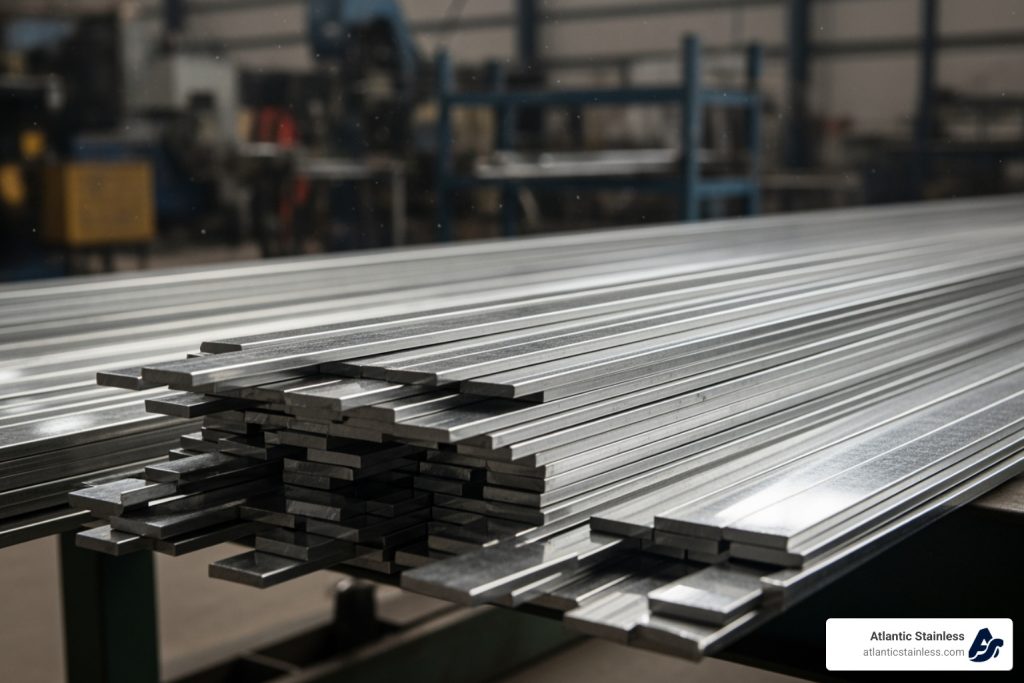
Stainless steel flat bar is a long, rectangular piece of metal with a flat surface and uniform thickness. It’s one of the most versatile materials in industrial and architectural applications because it combines exceptional durability with excellent corrosion resistance.
Whether you’re building structural supports, fabricating food processing equipment, or installing marine hardware, stainless steel flat bar delivers reliability in demanding environments. It resists rust and staining, requires minimal maintenance, and provides a clean, professional appearance.
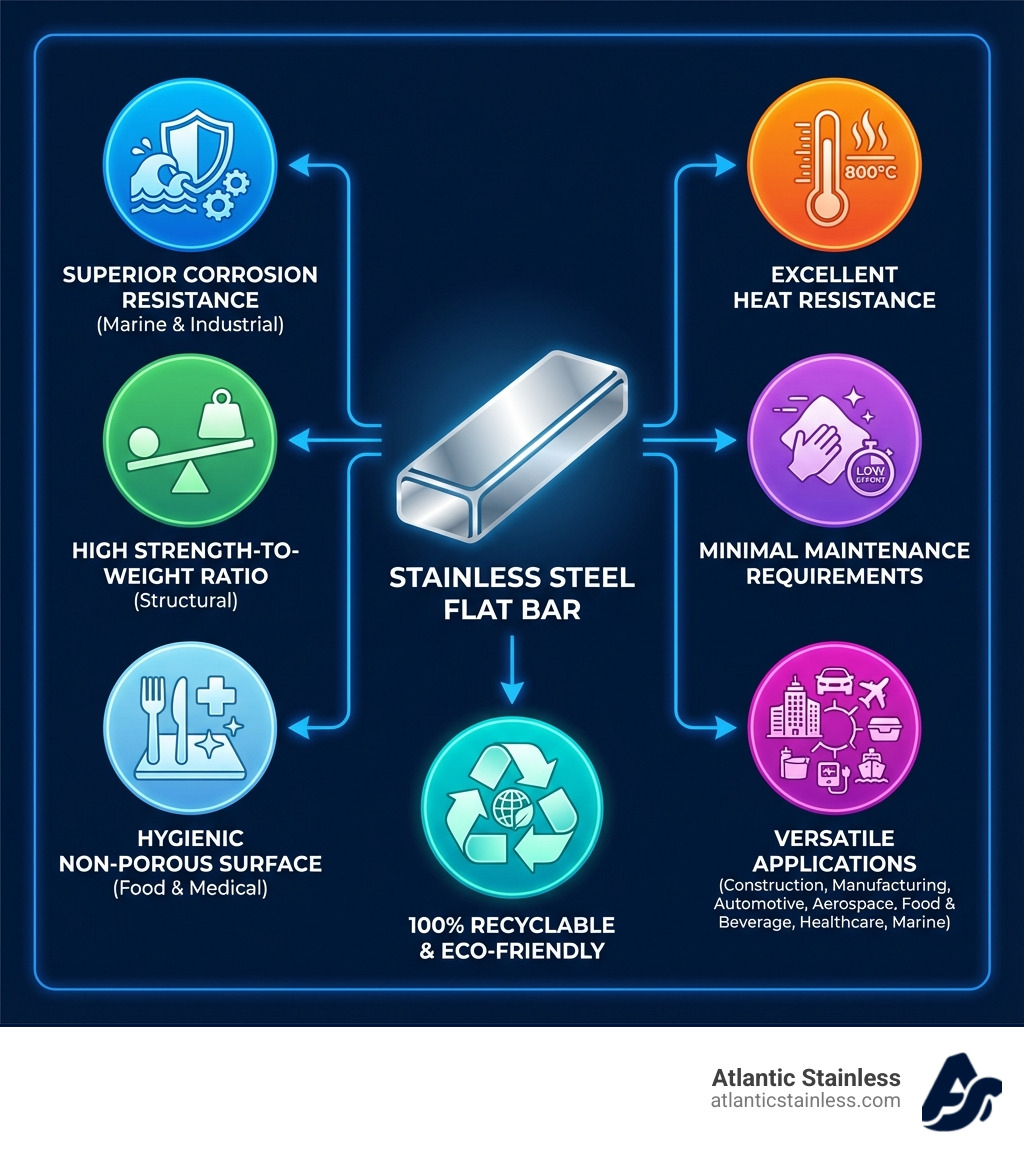
The material’s strength-to-weight ratio makes it suitable for load-bearing applications, while its non-porous surface meets strict hygiene standards in healthcare and food service industries. Plus, stainless steel is 100% recyclable, making it an environmentally responsible choice.
Understanding Stainless Steel Flat Bar: Grades, Properties, and Finishes
When you set out to buy stainless steel flat bar, understanding the various grades, how they’re specified, and the finishes available is crucial. It’s not just about getting a piece of metal; it’s about choosing the right piece of metal for your specific needs. Let’s explore the details.
Primary Grades: 304 vs. 316 Stainless Steel
The world of stainless steel can seem complex, but for flat bars, two grades stand out as the most common and versatile: 304 and 316. Knowing their differences is key to making an informed decision.
304 Stainless Steel
Grade 304 is often hailed as the workhorse of the stainless steel family, and for good reason! It’s the most widely used stainless steel globally, making up a significant portion of all stainless steel applications. Why is it so popular?
- Versatility: It’s incredibly versatile, suitable for a vast array of general fabrication projects.
- Corrosion Resistance: It offers excellent resistance to oxidation and corrosion, especially in atmospheric and fresh water environments. This makes it ideal for projects exposed to the elements.
- Workability: If you’re planning to weld or form your flat bar, 304 is your friend. It’s known for being easy to weld and work with, allowing for smooth fabrication processes.
- Cost-Effectiveness: Generally, 304 stainless steel flat bar is the more economical choice compared to its more specialized counterparts. It provides a fantastic balance of performance and price.
You’ll find 304 stainless steel flat bar commonly used for braces, trim, supports, and frames in many industries. Its durable, dull, grainy mill finish makes it a go-to for projects where strength and superior corrosion resistance are required without the need for a high-polish aesthetic.
316 Stainless Steel
Now, let’s talk about the tougher, more specialized sibling: 316 stainless steel. While 304 is excellent for general purposes, 316 steps in when the environment gets really harsh.
- Superior Corrosion Resistance: The secret to 316’s improved performance lies in its molybdenum content. This added element gives it significantly superior corrosion resistance, particularly against chlorides, bromides, iodides, and sulfuric acid. This makes it a champion in environments where 304 might falter.
- Marine Environments: Its excellent resistance to rust and corrosion from saltwater makes 316 the preferred choice for marine applications like boat fittings, deck hardware, and other components exposed to harsh sea conditions.
- High-Corrosion Settings: Beyond the sea, 316 excels in chemical processing plants, food processing machinery where strong cleaning agents are used, and medical device components where hygiene and resistance to aggressive substances are paramount. In fact, scientific research has consistently shown 316’s resilience against various corrodents, making it a reliable choice for challenging industrial settings. You can read more about its resistance to corrodents in detailed studies such as this one on Onepetro.
- Heat Resistance: 316 also delivers superior heat resistance, making it suitable for applications that experience liftd temperatures.
While 316 stainless steel flat bar is typically more expensive than 304, the investment often pays off by eliminating the need for costly secondary services to resist corrosion down the line. For more in-depth information on various stainless steel grades and their properties, we recommend exploring our comprehensive guide on Stainless Grades.
Key Specifications: Measurements, Finishes, and Mechanical Properties
When you buy stainless steel flat bar, understanding its specifications is like reading a blueprint for its performance and appearance.
Measurement
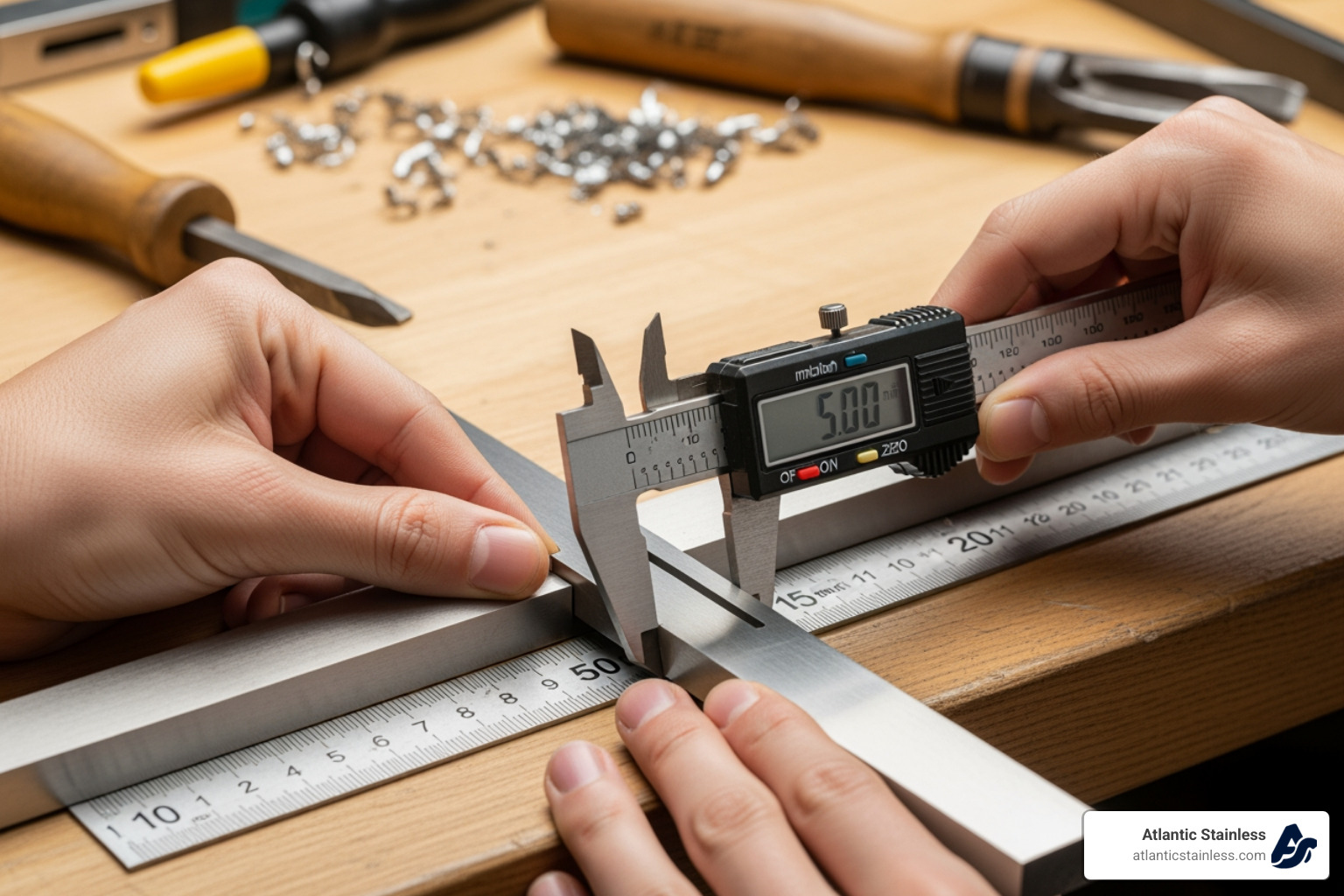
Flat bars are straightforward to measure, but precision is key. We typically specify them by:
- Thickness: This is the first dimension you’ll hear, measured perpendicular to the flat surfaces of the bar. It’s a critical factor because it directly impacts the bar’s strength and structural integrity. For example, our stock often ranges from 1/8″ to 2″ thick.
- Width: The second dimension, measured across the flat surface from one edge to the opposite edge. We supply widths up to 8″.
- Length: The overall length of the bar. Sheared & edged bar typically comes in 12′ bars while true bars are stocked in 12′-14′ randoms. If longer lengths are required, it can usually be produced.
So, a typical specification might be “1/8″ thick x 2″ wide x 12′ long.”
Finishes
The finish of a stainless steel flat bar can affect both its aesthetic appeal and its functional properties, especially for sanitary applications.
- Mill Finish: This is the standard, as-produced finish. For 304 stainless steel flat bar, this means a durable, dull, grainy appearance. It’s important to know that 304 flat bars with a mill finish are not polished. This is perfectly acceptable for many industrial and structural applications where a pristine, reflective surface isn’t required.
- Polished Finish: For applications demanding a brighter, more reflective, or sanitary surface, a #4/brushed finish can be provided. A polished finish can be applied to all four sides of the bar, making it ideal for architectural elements like railings, handrails, or in food and healthcare environments where cleanliness and appearance are paramount.
Mechanical Properties
Stainless steel flat bars offer a remarkable balance of mechanical properties, making them suitable for high-stress conditions without deforming or breaking. These properties include:
- Tensile Strength: The maximum stress a material can withstand while being stretched or pulled before breaking.
- Yield Strength: The stress at which a material begins to deform plastically (permanently).
- Hardness: Resistance to indentation or scratching.
- Ductility: The ability of a material to deform under tensile stress without fracturing.
For 304 stainless steel, typical mechanical properties are:
- Brinell Hardness: Approximately 170
- Tensile Strength: Approximately 85,000 psi
- Yield Strength: Approximately 34,000 psi
- It is also nonmagnetic.
While 316 stainless steel shares many similar mechanical properties with 304, its key advantage lies in its superior corrosion resistance rather than significantly different strength values. For most applications, its tensile and yield strengths are comparable to 304, though specific values can vary depending on the exact sub-grade (e.g., 316L) and processing.
Sheared & Edge-Conditioned vs. True Flat Bar: What’s the Difference?
When you buy stainless steel flat bar, you might encounter terms like ‘sheared and edge-conditioned’ and ‘true flat bar’. These refer to different manufacturing methods, which impact the bar’s characteristics, tolerances, and ultimately, its suitability for your project.
Sheared and Edge-Conditioned Flat Bar
Imagine a large sheet of stainless steel. A sheared and edge-conditioned flat bar is essentially cut from this plate.
- Production Method: These bars are cut (sheared) from a larger stainless steel plate. After shearing, the edges are often conditioned to remove any sharp burrs, providing a uniform edge quality.
- Cost-Effectiveness: Because they are cut from readily available plate stock, sheared and edge-conditioned bars are generally more cost-effective.
- Tolerances: While the edges are uniform, the overall tolerances might not be as tight as a true flat bar. For very thin strips, especially 1/16″, they might exhibit a slight curvature or twist as they are sheared from sheet.
- Availability: We stock sheared and edge-conditioned bars in a wide range of sizes, typically for thicknesses up to 1/2″.
True Flat Bar
A true flat bar, on the other hand, is produced through a different, more refined process.
- Production Method: True flat bars are typically produced by extrusion or hot rolling, annealing, and pickling (HRAP), or cold drawing. These processes form the bar directly into its final rectangular shape.
- Tighter Tolerances: The primary advantage of true flat bars is their tighter dimensional tolerances. This means the thickness and width are more consistently precise along the entire length.
- Sharp Corners: True flat bars boast sharp, 90-degree corners, which can be crucial for certain aesthetic or functional applications where a clean, crisp edge is desired.
- Availability: Thicker sizes, typically over 1/2″, are often produced as true flat bars. For applications demanding the precision of a true flat bar in thinner sizes, we can often source them upon request.
We’re proud to stock both sheared and true flat bar options, ensuring you have the right material for any project. For a more detailed look at the distinctions, check out our article on the Difference Stainless Steel Flat Bar Sheared vs. Edged.
Why Choose Stainless Steel Flat Bar? Benefits and Applications
Why do so many industries choose to buy stainless steel flat bar over other materials? The answer lies in its impressive array of benefits and its adaptability across countless applications.
Best Benefits Over Other Materials
Stainless steel flat bar isn’t just another metal; it’s a superior choice for environments that demand resilience and reliability.
- Corrosion Resistance: This is arguably stainless steel’s most celebrated trait. It’s inherently resistant to rust, staining, and corrosion. Unlike materials that might corrode and weaken over time, stainless steel maintains its integrity when exposed to moisture, chemicals, and other corrosive elements, making it perfect for marine and industrial settings.
- Durability and Strength: Stainless steel flat bars can withstand high-stress conditions without deforming or breaking. They offer an excellent strength-to-weight ratio, which means you get robust structural support without excessive bulk, making them suitable for construction, structural applications, and heavy-duty machinery.
- Hygiene: For applications where cleanliness is paramount, stainless steel shines. Its non-porous surface is easy to clean and does not harbor bacteria or other pathogens. This hygienic property makes stainless steel flat bars a preferred material in the food and beverage industry, as well as healthcare settings.
- Low Maintenance: Who doesn’t love a material that looks good and performs well with minimal fuss? Stainless steel flat bars require very little maintenance, saving time and resources over their lifespan.
- Heat Resistance: Many grades of stainless steel flat stock offer excellent heat resistance. This makes them highly suitable for high-temperature applications, such as manufacturing processes, automotive components, and other demanding industrial uses where heat is a factor.
- 100% Recyclable: In an age where environmental responsibility is key, stainless steel stands out. It is 100% recyclable, making it an environmentally friendly and sustainable material choice.
- Aesthetic Appeal: Beyond its functional benefits, stainless steel offers a clean, modern, and polished look. This makes it a favorite for architectural designs, decorative fixtures, and applications where aesthetics are as important as performance.

Common Industries and Real-World Applications
The versatility of stainless steel flat bar means it pops up in an incredible range of projects and industries. It’s a true workhorse!
- Construction: From reinforcing concrete structures to providing additional strength and durability, stainless steel flat bars are integral. They’re also used as braces, supports, and framework.
- Manufacturing: Used to fabricate a variety of machinery parts, brackets, clamps, and fixtures, offering robustness and longevity. They’re essential for industrial tools and mechanical components.
- Automotive: Found in car parts that demand high strength and resistance to wear and corrosion, contributing to vehicle safety and longevity.
- Aerospace: Used in aircraft components and structural parts due to its high strength-to-weight ratio and corrosion resistance, crucial for safety and performance.
- Food & Beverage: Due to their hygienic properties, stainless steel flat bars are ideal for making kitchen equipment, food processing machinery, storage tanks, and sanitary framing for production lines.
- Healthcare: Frequently used to manufacture medical devices, surgical instruments, and hospital furniture, where sterilization and non-corrosive properties are critical.
- Marine: Due to its excellent resistance to rust and corrosion from saltwater, stainless flat bar is commonly used for boat fittings, deck hardware, and other marine applications, as well as in supports and railing systems exposed to the elements.
- Energy Sector: Employed to construct pipelines, valves, and other components that require resistance to corrosive environments, including applications in solar panel frames and wind turbine components.
- Architectural: Stainless steel flat bars are often used in architectural designs for railings, handrails, trim, and other decorative fixtures that require a polished, modern look.
From the visible elegance of architectural trim to the unseen strength of structural supports, stainless steel flat bar is doing a fantastic job. For more insights into how steel bars are used across different sectors, you can explore our article on steel bar applications.
Your Guide to Buy Stainless Steel Flat Bar
So, you’re ready to buy stainless steel flat bar? Excellent choice! Now, let’s walk through how to ensure you get exactly what you need for your project and how to find a supplier you can trust.
How to buy stainless steel flat bar for your project
Making the right purchase involves a few key considerations:
- Assess Your Project Needs: Begin by clearly defining the demands of your project.
- Environmental Exposure: Will the flat bar be exposed to moisture, chemicals, saltwater, or extreme temperatures? This will heavily influence your grade selection.
- Structural Load: What kind of weight or stress will the bar need to support? This determines the necessary thickness and potentially the grade.
- Aesthetic Requirements: Does the appearance matter? For visible architectural elements, a polished finish might be crucial, whereas for internal structural components, a mill finish is perfectly adequate.
- Specify Dimensions: Precision in dimensions is paramount.
- Thickness: Determine the required thickness (e.g., 1/8″, 1/4″, 1/2″). Thickness impacts strength.
- Width: Specify the width needed (e.g., 1″, 2″, 4″).
- Length: Decide on the exact lengths you need. While standard lengths (12′ or 20′) are common, many suppliers offer cut-to-size services, which can be a huge advantage.
- Choose the Right Grade: Based on your environmental and structural assessments, select the appropriate stainless steel grade.
- 304 for General Use: For most indoor applications, general fabrication, or outdoor settings with moderate environmental exposure (e.g., fences, bracing), 304 stainless steel is typically the most cost-effective and suitable choice.
- 316 for High-Corrosion Areas: If your project involves marine environments, chemical processing, or exposure to harsh acids and chlorides, investing in 316 stainless steel will provide the superior corrosion resistance needed for longevity and performance.
For further guidance on material selection, especially when dealing with various stainless steel alloys, our Stainless Steel Material Selection Guide offers valuable insights.
Finding the Right Supplier: What to Look For
Choosing where to buy stainless steel flat bar is almost as important as choosing the bar itself. A reliable supplier can make all the difference in terms of quality, service, and project success.
Here’s what we believe you should look for:
- Comprehensive Product Range: A top-tier supplier should offer a wide variety of stainless steel flat bar options. This includes different grades (like 304 and 316), a broad spectrum of thicknesses and widths (from 1/8″ to 3/4″ thick and up to 10″ wide, for example), and various lengths. The more options, the more likely you’ll find exactly what you need in stock.
- In-Stock Availability: Time is money, and waiting for materials can derail a project. Look for a supplier with extensive inventory and strong in-stock availability. This ensures prompt delivery and keeps your project on schedule.
- Customization Services: Very few projects require off-the-shelf standard lengths. Value-added processing services are a game-changer.
- Cut-to-Size: Whether it’s saw cutting, shearing, water jet, or laser cutting, the ability to get your flat bar cut to precise dimensions saves you time, effort, and waste.
- Polishing and Finishing: For aesthetic or sanitary applications, a supplier offering in-house polishing (e.g., #3, #4, #6 finishes) is invaluable.
- Expertise and Service: You’re not just buying metal; you’re buying a solution. A good supplier will have knowledgeable staff who can guide you through material selection, answer technical questions, and help you steer the complexities of your project. Prompt delivery and responsive customer service are hallmarks of a reliable partner.
- Reputation and Experience: Look for a supplier with extensive industry experience and a strong reputation for quality and reliability.
At Atlantic Stainless, we pride ourselves on being a nationwide supplier and processor of high-quality stainless steel, backed by extensive industry experience. We offer a wide variety of in-stock products, prompt delivery, and best service to customers across the USA and worldwide from our North Attleboro, Massachusetts location. When you’re ready to discuss your specific needs, don’t hesitate to Request a Quote.
Frequently Asked Questions about Stainless Steel Flat Bar
We know you might have more questions when you decide to buy stainless steel flat bar. Here are some of the most common inquiries we receive:
How is stainless steel flat bar measured?
Stainless steel flat bar is typically measured by its thickness first, then its width, and finally its length. For example, a common specification might be “1/8″ x 1/2″ x 12′”. The thickness measurement is taken perpendicular to the flat surfaces of the bar, and it’s a critical dimension as it directly impacts the bar’s strength and structural integrity. The width is the distance across the flat surface from one edge to the opposite edge.
Can I get stainless steel flat bar cut to a specific size?
Absolutely! Most reputable suppliers, including us, offer value-added processing services like saw cutting or shearing. This allows you to buy stainless steel flat bar cut to your exact specifications, eliminating waste and saving you valuable time and resources during your fabrication or installation process. Just provide your required dimensions, and we’ll handle the precision cutting.
What is the standard finish on a 304 stainless steel flat bar?
The standard finish for 304 stainless steel flat bar is typically a durable, dull, grainy mill finish. This is the condition of the material as it comes from the mill, before any additional processing like polishing. This mill finish is generally not polished. If your project requires a brighter, more reflective, or sanitary surface, a #4/brushed finish can be requested as an additional service.
Conclusion
As we’ve explored, deciding to buy stainless steel flat bar means investing in a material that offers an exceptional combination of strength, superior corrosion resistance, and remarkable versatility. Whether you’re constructing a robust framework, crafting intricate architectural details, or building equipment for demanding marine or food processing environments, stainless steel flat bar stands as a reliable and enduring choice.
We’ve covered the critical differences between grades like 304 (the versatile workhorse) and 316 (the high-corrosion champion), discussed how these essential materials are measured and finished, and clarified the distinctions between sheared and true flat bars. The myriad benefits—from hygiene and low maintenance to recyclability and aesthetic appeal—make a compelling case for its widespread use across countless industries.
The success of your project hinges not only on choosing the right grade and specifications but also on partnering with a knowledgeable and well-stocked supplier. At Atlantic Stainless, we are proud to be a nationwide supplier, dedicated to providing high-quality Products and custom processing capabilities to meet your unique needs. We believe in delivering not just material, but also expertise and reliable service.
For your next project, whether it’s large or small, simple or complex, we invite you to explore our extensive inventory of stainless steel flat bar and experience the Atlantic Stainless difference.