5 Effective Tips for Choosing Stainless Steel Polishing Services
Why Choosing the Right Stainless Steel Polishing Services Matters
Stainless steel polishing services are specialized finishing operations that smooth and refine metal surfaces to meet exact aesthetic, hygienic, or functional requirements.
Quick answer — what to look for in a stainless steel polishing provider:
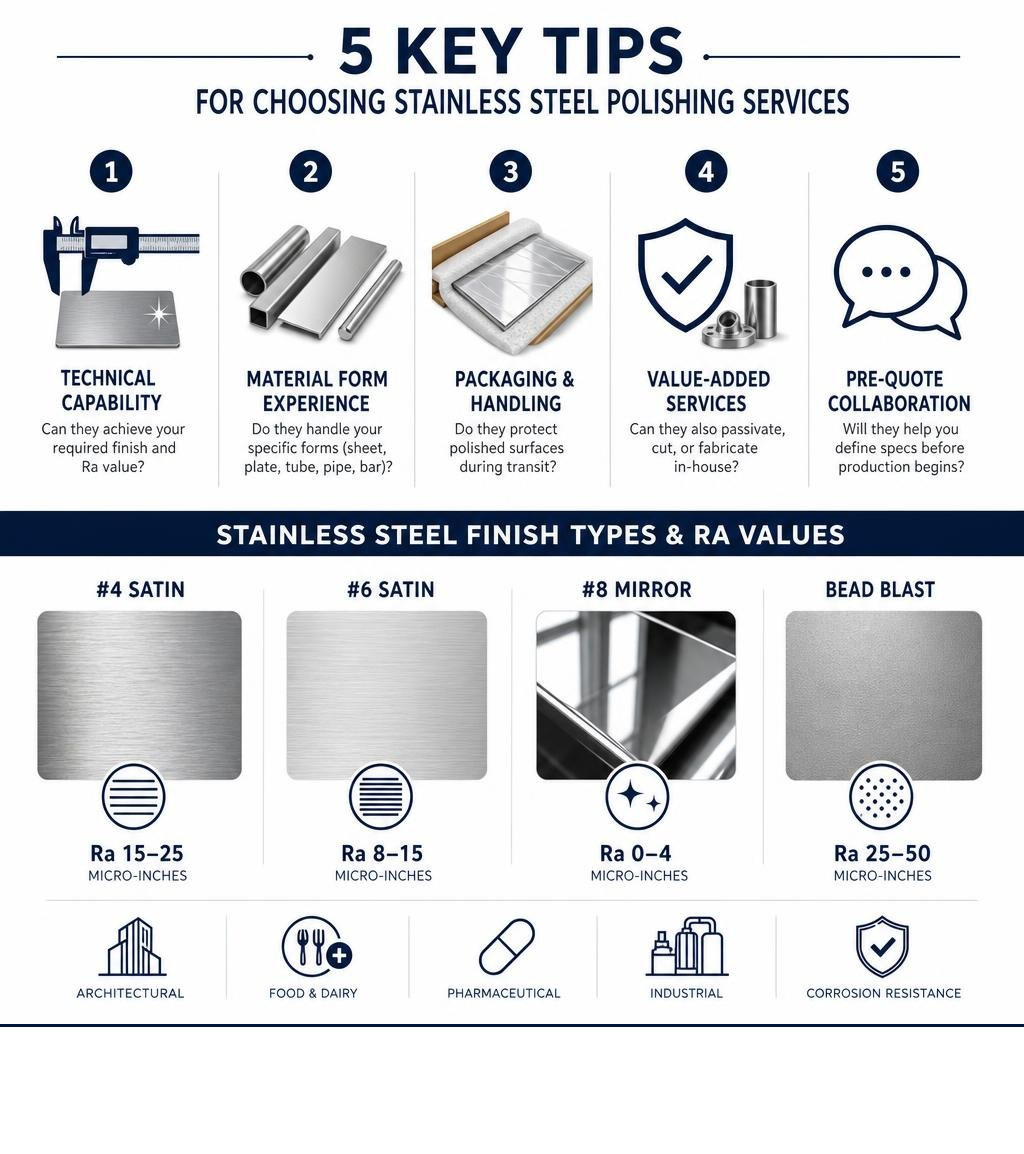
- Technical capability — Can they achieve your required finish (#4, #8, mirror) and Ra value?
- Material form experience — Do they handle your specific forms (sheet, plate, tube, pipe, bar)?
- Packaging and handling — Do they protect polished surfaces during transit?
- Value-added services — Can they also passivate, cut, or fabricate in-house?
- Pre-quote collaboration — Will they help you define specs before production begins?
Getting a polished stainless steel finish right is harder than it looks. The difference between a #4 satin finish (Ra 15–25 micro-inches) and a #8 mirror finish (Ra 0–4 micro-inches) isn’t just visual — it affects corrosion resistance, hygiene performance, and how the part performs in the field.
The wrong provider can deliver inconsistent grain direction, surface distortion, or finishes that don’t meet your spec. That’s a costly problem, especially on large architectural panels, sanitary tubing, or precision fabrications.
Whether you’re sourcing polished sheet for a building facade or tube for a pharmaceutical application, the tips below will help you find a provider that gets it right.
5 Essential Tips for Selecting Stainless Steel Polishing Services
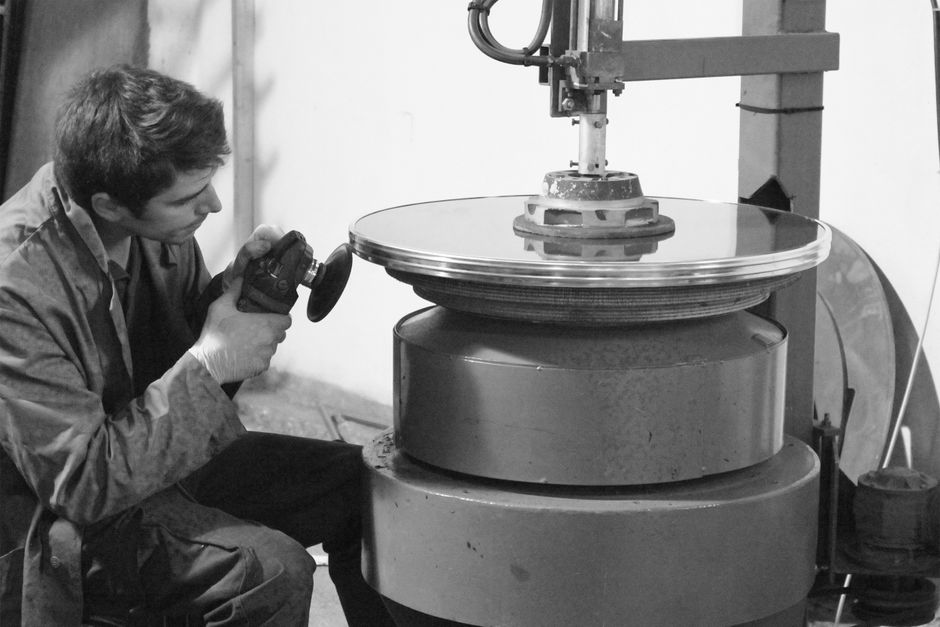
When evaluating stainless steel polishing services, it helps to understand that polishing is a highly technical, multi-stage discipline. Achieving a flawless surface involves a careful balance of mechanical abrasive sequences, chemical properties, and metallurgy.
Mechanical polishing relies on physical abrasives to shave down the microscopic “peaks and valleys” of a raw metal surface. This process typically requires anywhere from three to seven distinct stages, starting with a coarse grit (around 50 grit) and gradually stepping up to ultra-fine abrasives (up to 3,000 grit) or buffing compounds.
Alternatively, chemical methods like electropolishing use an acid bath and an electrical current to dissolve surface metal at a molecular level. This removes micro-burrs and eliminates surface contaminants without putting mechanical stress on the part.
As you look for the ideal partner, keep the following five tips in mind to ensure your project is completed to the highest standards.
1. Verify the Technical Capabilities of Stainless Steel Polishing Services
The first step in choosing a provider is verifying that they can technically achieve and measure the exact finish your project requires. Different industries speak different finishing languages—some specify standard finish numbers (like #4 or #8), while others rely strictly on quantitative surface roughness measurements like Ra (Roughness Average) or RMS (Root Mean Square).
To help you visualize these differences, here is a quick breakdown of standard stainless steel finishes and their technical specifications:
| Finish Designation | Common Name | Typical Grit Range | Roughness (Ra in Micro-Inches) | Typical Applications & Industries |
|---|---|---|---|---|
| No. 3 | Coarse Satin | 60 – 80 | 25 – 40 Ra | Food process machinery, preliminary grinding |
| No. 4 | Standard Satin | 120 – 180 | 15 – 25 Ra | Restaurant kitchens, dairy equipment, storefronts |
| No. 6 | Dull Satin | 240 – 320 | 12 – 18 Ra | Architectural trim, low-reflective paneling |
| No. 7 | Semi-Mirror | 280 – 320 (buffed) | 4 – 8 Ra | Ornamental trim, custom lighting fixtures |
| No. 8 | True Mirror | Alumina buffed | 0 – 4 Ra | Cleanroom press plates, reflectors, architectural mirrors |
A professional provider must have the specialized equipment—such as a profilometer—to measure and verify these Ra values. If your application is in a highly regulated field like food processing or pharmaceuticals, a generic “shiny” finish won’t cut it. You will need documented proof that the surface is smooth enough to prevent bacterial adhesion.
To dive deeper into how these finishes are produced and measured, take a look at our detailed A Guide to Polishing Stainless Steel. When you are ready to discuss your specific roughness targets, you can explore our professional Polishing Services to see how we align our machinery with your technical specifications.
2. Understand the Impact of Material Forms and Shapes

Polishing a flat, wide sheet of stainless steel is a completely different operational challenge than polishing the inside of a sanitary tube or the complex curves of a custom-welded bracket.
- Sheets and Plates: These are typically processed on large, automated wide-belt sanding machines. Advanced industrial equipment can handle sheet widths up to 72 inches and beyond, and accommodate plates up to 24 feet in length.
- Tubes, Pipes, and Bars: Cylindrical shapes require specialized centerless polishing equipment that rotates the material against abrasive belts. For sanitary applications, polishing the inner diameter (ID) is just as critical as the outer diameter (OD) to prevent material build-up inside the process lines.
- Custom Fabrications: Once parts are welded, bent, or assembled, automated polishing is rarely an option. Hand-held rotary tools and specialized manual buffing are required to polish tight angles and weld seams.
Because different shapes require different machinery, you should always ask a potential provider about their dimensional and weight limits. For instance, can they handle oversized plates weighing up to 9,000 pounds? Do they have the specialized equipment for ID spin polishing on large tanks?
Understanding how your material’s shape affects the final finish is crucial. To learn more about how different finishes look on various metal shapes, read our comparison of Polished Stainless Steel vs. Satin Stainless Steel.
3. Evaluate the Material Handling and Packaging of Stainless Steel Polishing Services
A flawless, high-luster #8 mirror finish is incredibly delicate. If a polished sheet is allowed to rub against another metal surface during transport, or if a polished tube is loaded onto a truck without protection, the finish will be ruined before it ever reaches your facility.
When evaluating stainless steel polishing services, you must ask how they protect the finished material during handling and transit. Professional polishers use a variety of surface protection strategies:
- Adhesive PVC Films: Applying a heavy-duty plastic film to the polished surface protects it from scratches during subsequent fabrication, laser cutting, or installation.
- Paper Interleaving: Placing specialized paper sheets between polished plates prevents metal-on-metal friction during transport.
- Sleeving and Wrapping: Individual tubes and pipes should be placed in plastic sleeves or wrapped in protective film to keep them pristine.
- Custom Crating: For domestic or international shipping, heavy-duty wooden crates or custom pallets are essential to prevent shifting.
At Atlantic Stainless, we treat material preservation as an essential step in our process. We ensure that your polished metals are carefully packaged to survive the journey to your shop floor. Learn more about our comprehensive material handling on our Atlantic Stainless Services page.
4. Look for Value-Added Processing and Fabrication Capabilities
Your supply chain is much more efficient when you can source, cut, polish, and treat your metal under one roof. Working with a single-source provider reduces transit times, minimizes the risk of material damage during shipping between different vendors, and simplifies your quality control.
When choosing a polishing partner, look for these key value-added services:
- Precision Cutting: Utilizing dynamic waterjet cutting or high-definition plasma cutting allows you to get your polished parts cut to tight tolerances without heat distortion.
- Passivation: Mechanical polishing can occasionally embed microscopic iron particles from abrasive belts into the stainless steel surface. Passivation uses an acid bath (nitric or citric) to strip away free iron, restoring the natural chromium oxide passive layer that makes stainless steel rust-resistant.
- Electropolishing: For architectural components facing harsh coastal environments or acid rain, combining mechanical polishing with architectural metal electropolishing creates a ultra-smooth, chrome-like surface that eliminates tea staining and rust bleeding for the lifetime of the installation.
By selecting a partner that offers both raw metal distribution and advanced processing, you save time and money. Check out our main Services page to see our full capabilities, or read about how different finishing methods impact material longevity in our guide on Polished Stainless Steel vs. Satin Stainless Steel.
5. Prioritize Pre-Quote Collaboration and Clear Specifications
The most common cause of a disappointing polishing job is a lack of communication before the work begins. “Polished” is a subjective term; what looks like a great finish to one person might be unacceptable to an inspector in a pharmaceutical facility.
To ensure consistent quality, look for a provider that insists on aligning technical specifications before issuing a quote.
What to Include in Your Polishing RFQ (Request for Quote):
- Exact Finish Type & Target Ra: Specify the numbered finish or the maximum allowable surface roughness in micro-inches.
- Number of Polished Faces: Clarify if you need one-sided polishing, two-sided polishing, or edge polishing.
- Grain Direction: For grained finishes (like No. 4 satin), specify which direction the grain must run. This is critical for architectural panels that must match visually when installed side-by-side.
- Pit and Imperfection Tolerance: Define the acceptable level of minor surface pits, which can vary depending on whether the starting material is hot-rolled or cold-rolled.
- Inspection Standards: Outline how the finish will be inspected (e.g., visual inspection at a specific distance, or mandatory profilometer testing).
- Packaging Preferences: Specify if you require laser-vinyl PVC, standard protective film, or paper interleaving.
By establishing these parameters early, you avoid costly re-work and production delays. We believe in partnering with our customers from day one to ensure there are no surprises. You can read more about our collaborative approach on our dedicated Polishing page.
Conclusion: Partnering for Precision Metal Finishing
Whether you are working on a high-profile architectural lobby in Boston, a sterile food processing line, or marine hardware designed to withstand salt spray, the quality of your stainless steel finish is paramount.
By verifying technical capabilities, understanding material shapes, ensuring proper packaging, leveraging value-added services, and aligning on specifications early, you can choose a partner that delivers perfect results every time.
We are proud to continue expanding our processing capabilities to better serve your needs. Learn more about our expanded capacity in our official announcement, Atlantic Stainless Launches New Polishing Service.
Based in North Attleboro, Massachusetts, Atlantic Stainless is your trusted partner for high-quality metal distribution and precision finishing. Ready to start your next project? Visit our Polishing service page today to request a quote or connect with one of our metal finishing specialists.