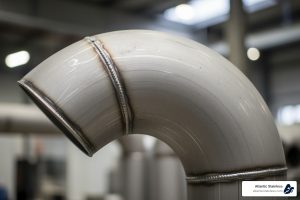
What’s the Deal with Long and Short Radius Elbows?
Understanding Pipe Elbow Types: Why the Radius Matters
Last updated on May 20th, 2026 at 11:57 am
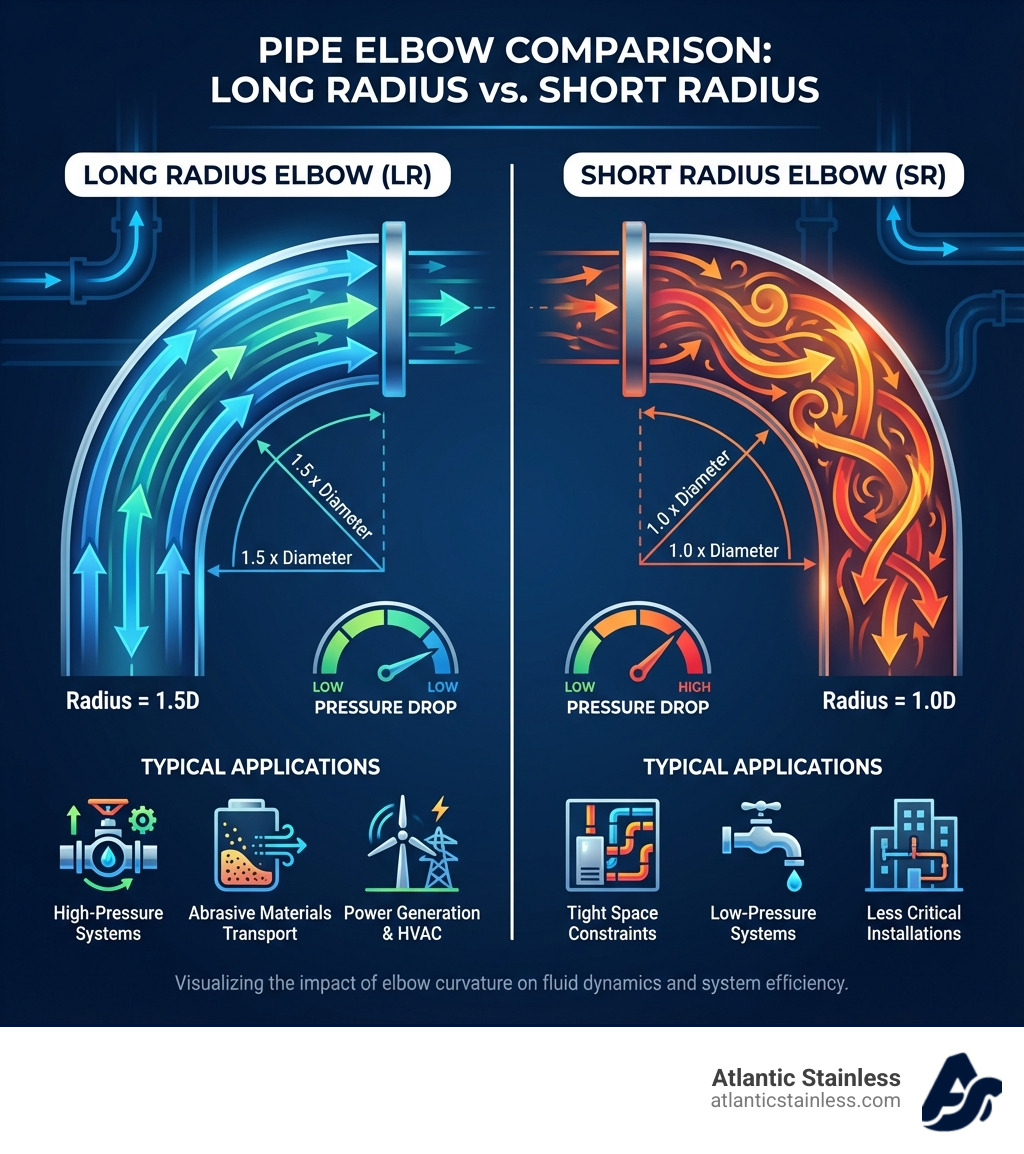
Long radius elbows are pipe fittings designed to change the direction of flow in a piping system with a centerline radius equal to 1.5 times the pipe’s nominal diameter (1.5D). Here’s what you need to know:
Key Characteristics:
- Radius Formula: R = 1.5D (where D is the nominal pipe size)
- Primary Benefit: Reduced pressure drop and smoother fluid flow
- Best For: High-pressure systems, high-velocity applications, and transporting abrasive materials
- Common Angles: 45° and 90° bends
- Standard: ASME B16.9 for buttwelding fittings
Compared to Short Radius Elbows:
- Long radius (LR) = 1.5D centerline radius
- Short radius (SR) = 1.0D centerline radius
- LR provides less turbulence and friction loss
- SR requires less space but causes higher pressure drop
If you’re sourcing pipe fittings for industrial, chemical processing, or power generation systems, understanding the difference between long and short radius elbows directly impacts your system’s efficiency and operating costs.
The radius of curvature determines how smoothly fluid can steer a directional change. A gentler bend means less turbulence, reduced erosion, and lower energy costs for pumping. This is especially critical when handling slurries, abrasive fluids, or operating at high flow rates.
Long radius elbows are available in sizes from 1/2 inch to over 48 inches, manufactured from materials including stainless steel, carbon steel, and various alloys. They’re essential components in oil and gas pipelines, petrochemical plants, water treatment facilities, HVAC systems, and power generation installations.
The choice between long and short radius elbows isn’t just about fitting pipes together—it’s about optimizing your entire system’s performance, longevity, and operational efficiency.
Defining the Bend: Long Radius vs. Short Radius Elbows
When it comes to altering the direction of flow in a piping system, elbows are our go-to fittings. But not all elbows are created equal! The primary distinction lies in their radius of curvature, leading us to the two main types: long radius elbows (LR) and short radius elbows (SR).
A long radius elbow is characterized by a centerline radius that is 1.5 times the nominal pipe diameter (NPS) – often expressed as 1.5D. Imagine a gentle, sweeping curve; that’s your long radius elbow. For instance, a 12-inch NPS long radius elbow will have a center-to-face dimension of 18 inches, allowing for a more gradual change in direction. This design choice isn’t arbitrary; it’s engineered for optimal fluid dynamics.
In contrast, a short radius elbow has a centerline radius equal to the nominal pipe diameter (1.0D). This means the bend is much tighter. While it saves space, this abrupt change in direction comes with certain trade-offs that we’ll explore.
We typically find long radius elbows available in common angles such as 45° and 90° bends, though other specific angles like 180° returns are also manufactured. Their dimensions are carefully standardized, ensuring compatibility and reliability across countless applications. For example, a small 1/2 inch NPS long radius elbow has a center-to-face dimension of 1.5 inches, while a larger 24 inch NPS long radius elbow measures 36 inches from center-to-face. These precise measurements, alongside the nominal pipe size (NPS) and outside diameter (O.D.) at the bevel, are all critical specifications we consider when selecting the right elbow for your project.
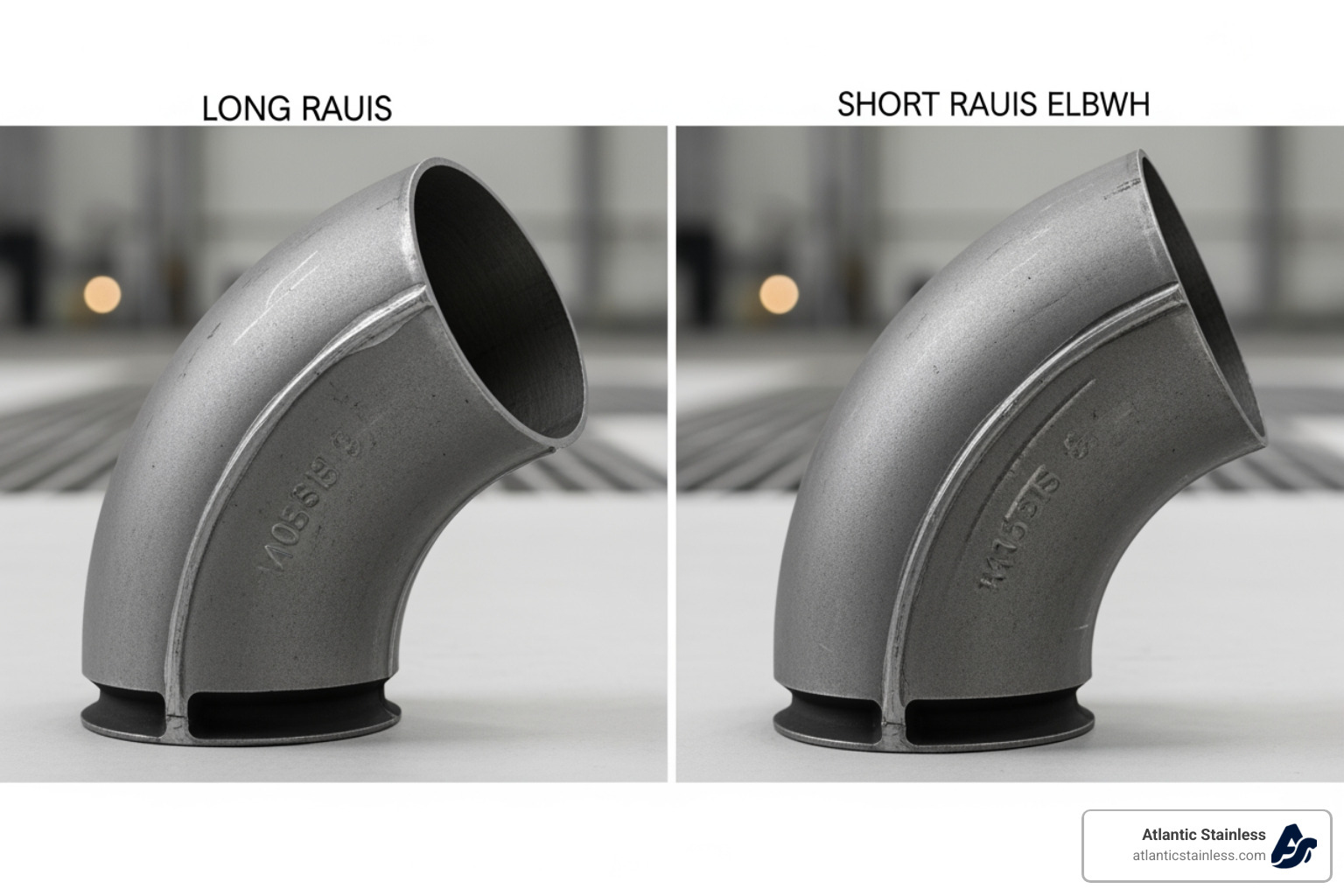
To make it even clearer, here’s a quick comparison:
| Metric | Long Radius (LR) Elbow | Short Radius (SR) Elbow |
|---|---|---|
| Radius Formula | R = 1.5D (1.5 times Nominal Pipe Diameter) | R = 1.0D (Equal to Nominal Pipe Diameter) |
| Pressure Loss | Lower | Higher |
| Space Required | More | Less |
| Cost | Often slightly higher due to material/manufacturing | Generally lower for the fitting itself |
| Typical Use Case | High-pressure, high-flow, abrasive media, critical efficiency | Space-constrained areas, low-pressure, non-critical flow |
The Significance of the Radius Ratio (R/D)
The radius-to-diameter ratio (R/D) is perhaps the most fundamental concept when discussing elbows. For long radius elbows, this ratio is consistently 1.5 (R/D = 1.5), meaning the radius of the bend is one and a half times the pipe’s nominal diameter. For short radius elbows, the ratio is 1.0 (R/D = 1.0).
Why does this ratio matter so much? It directly influences how smoothly fluid can steer the bend. A larger R/D ratio, like that of a long radius elbow, creates a more gradual turn. This gentle curve minimizes turbulence, reduces friction loss, and prevents drastic pressure drops within the system. Think of it like a highway curve: a long, sweeping bend allows traffic to maintain speed and flow smoothly, while a sharp, tight turn forces vehicles to slow down, causing congestion and potential hazards. In piping, this translates to better system performance and efficiency, which we’ll dig into next.
Dimensional Differences Explained
Understanding the precise dimensional differences between long radius elbows and their short radius counterparts is crucial for proper system design and installation. These dimensions, particularly the center-to-end measurements, are standardized by industry bodies like ASME B16.9 and B16.28. These standards dictate the exact measurements for various Nominal Pipe Sizes (NPS) and angles, ensuring interchangeability and predictable performance.
For a 90° long radius elbow, the center-to-face dimension is, as we’ve noted, 1.5 times the NPS. This dimension is measured from the center of the elbow’s curvature to the face of the fitting where it connects to the straight pipe. For example, a 12-inch NPS long radius elbow will have a 18-inch center-to-face dimension. In contrast, a 90° short radius elbow of the same NPS would have a center-to-face dimension equal to its NPS, meaning a 12-inch SR elbow would measure 12 inches center-to-face.
These differences are even more pronounced when considering 45° elbows or 180° returns, where the specific geometric configurations lead to unique center-to-end and back-to-face dimensions. You can find detailed dimensional data for elbows that engineers and designers rely on to plan piping layouts carefully. Our team at Atlantic Stainless is well-versed in these specifications, helping you select the precise fittings for your needs.
The Advantages of Long Radius Elbows
The choice of using long radius elbows often boils down to a desire for optimal system performance and longevity. Their design inherently offers several significant advantages that contribute to a more efficient and reliable piping network.
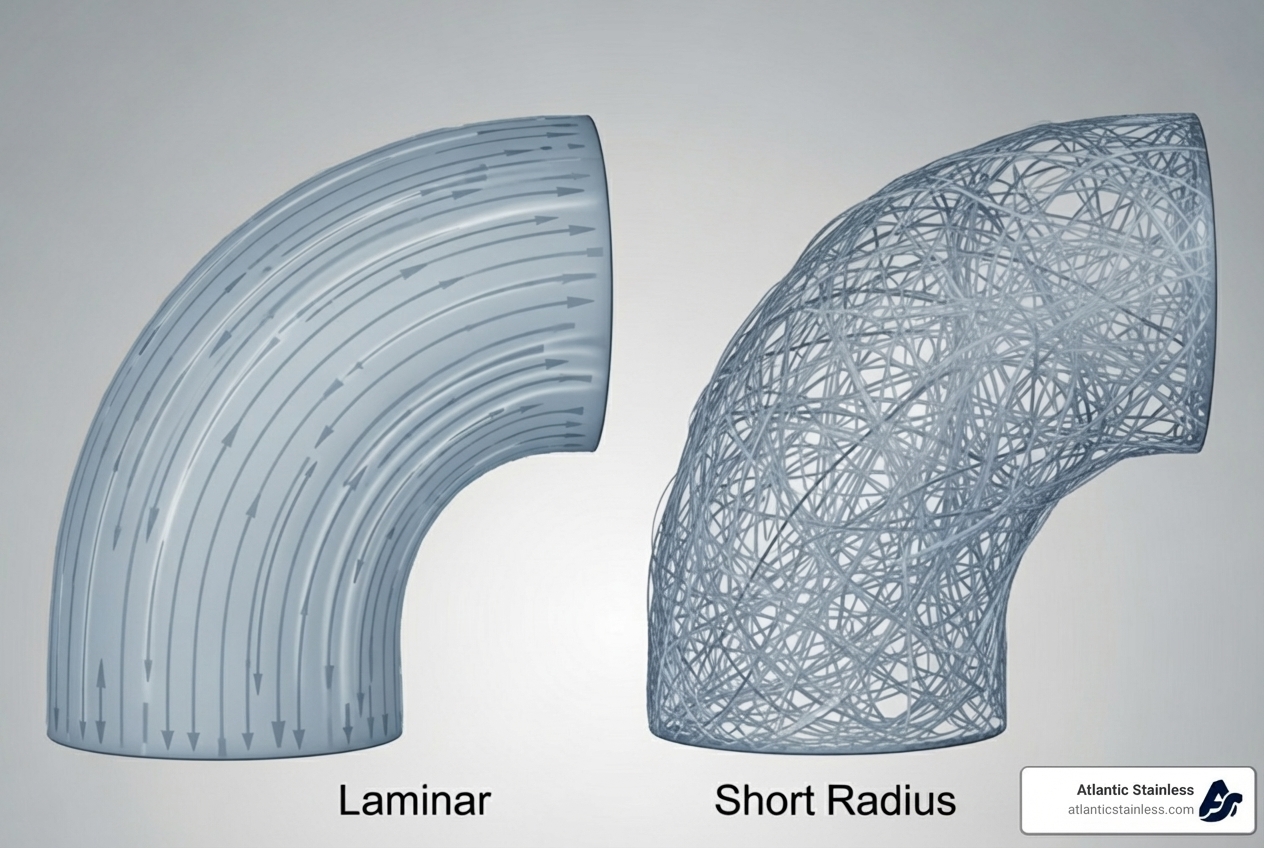
One of the most compelling advantages is the significant reduction in pressure drop. Because the fluid changes direction more gradually, there’s less kinetic energy lost to internal friction and turbulence. This means the pumps in your system don’t have to work as hard, leading to substantial energy savings over the operational life of the system. Less turbulence also translates to a smoother flow path and, consequently, lower friction within the pipe. This translates directly into improved system efficiency and reduced operational costs – a win-win in our book!
Enhancing System Longevity
Beyond immediate efficiency gains, long radius elbows play a crucial role in extending the lifespan of your entire piping system. The minimized turbulence and reduced impact on the pipe walls mean less erosion, especially when dealing with abrasive fluids or slurries. This is particularly important in industries where corrosive chemicals or particulate-laden liquids are transported.
By reducing internal stresses and vibrations caused by turbulent flow, long radius elbows contribute to lower wear and tear on the pipes, welds, and other fittings. This translates to fewer maintenance needs, reduced downtime, and a lower risk of costly leaks or failures. When we consider the investment in high-quality materials like stainless steel, protecting that investment through thoughtful component selection, such as using long radius elbows, simply makes good sense. For more information on how different materials stand up in various environments, you might find our insights on stainless steel tubing applications helpful.
Optimizing Flow and Performance
The smoother flow path offered by long radius elbows isn’t just about reducing pressure drop; it’s about optimizing the overall performance of the system. This allows for higher flow rates to be achieved with the same pumping power, or the same flow rate with less power. In applications transporting granular materials or powders, the gentle curve prevents blockages and minimizes material degradation, ensuring product integrity.
For systems handling sensitive or abrasive fluids, this smooth flow is paramount. It prevents the accumulation of material at the bend, which can lead to localized corrosion or erosion. Whether it’s in the demanding environments of petrochemical processing or the intricate networks of HVAC systems, the ability of long radius elbows to maintain consistent, efficient flow is invaluable. Our expertise extends to providing custom solutions for unique fluid handling challenges, and you can learn more about how we support custom applications with our specialized stainless steel products.
Key Specifications for Selecting Pipe Elbows
Selecting the correct pipe elbow is a critical step in designing and building a robust piping system. It’s not just about picking the right radius; a host of other specifications must be carefully considered to ensure performance, safety, and compliance.
At the heart of these specifications are industry standards, with ASME B16.9 being a paramount reference for wrought buttwelding fittings, including long radius elbows. This standard dictates everything from dimensional tolerances to material specifications and manufacturing requirements for fittings ranging from NPS 1/2 through NPS 48.
Beyond the radius, we must consider the wall thickness of the elbow, which is often specified by a “pipe schedule.” The schedule number (e.g., Schedule 10, Schedule 40, Schedule 80) indicates the wall thickness relative to the pipe’s nominal size, directly impacting the elbow’s pressure rating and mechanical strength. For long radius elbows, the wall thickness tolerance is typically within 12.5% of the minimum ordered wall thickness of the pipe, ensuring structural integrity even after forming. In some cases, providers might even offer one schedule greater thickness for butt weld elbows to guarantee sufficient wall thickness after the manufacturing process.
The connection type is another vital specification. For buttwelding fittings like our long radius elbows, the ends are typically beveled to facilitate a strong, full-penetration weld. This ensures a seamless and leak-proof connection to the pipe.
Finally, the angle of the elbow is chosen based on the required change in direction. The most common angles you’ll encounter are:
- 45°
- 90°
- 180°
Common Materials for Long Radius Elbows
The material chosen for long radius elbows is just as important as their geometry, as it dictates the fitting’s suitability for specific operating conditions, including temperature, pressure, and the corrosiveness of the fluid being transported. At Atlantic Stainless, we specialize in high-quality stainless steel and high-temperature alloys, which are excellent choices for many demanding applications.
Common materials for manufacturing long radius elbows include:
- Stainless Steel: Our bread and butter! Materials like 304/304L and 316/316L stainless steel are prized for their exceptional corrosion resistance, strength, and hygienic properties. They are ideal for applications in chemical processing, food and beverage, pharmaceuticals, and water treatment where purity and longevity are crucial.
- Carbon Steel: Economical and robust, carbon steel (e.g., ASTM A-53 Grade B, ASTM A234 WPB) is widely used for general industrial applications, oil and gas pipelines, and power generation, particularly where high strength and good weldability are required, and corrosion is managed through coatings or less aggressive media.
- Alloy Steel: These steels, often containing elements like chromium, molybdenum, or nickel, offer improved strength, toughness, and resistance to high temperatures or specific corrosive environments. They are common in power generation and petrochemical industries.
- Nickel Alloys: For the most aggressive environments, such as those involving strong acids or extreme temperatures, nickel alloys provide superior corrosion resistance and high-temperature strength.
The selection criteria for these materials are rigorous, considering factors such as operating temperature range, internal and external corrosive agents, required pressure rating, and the fluid’s abrasiveness. Our expertise in seamless vs. welded tubing also extends to fittings, ensuring you get the most appropriate solution for your system.
Understanding Standards like ASME B16.9
When we talk about the specifications of long radius elbows, one standard consistently rises to the top: ASME B16.9. This comprehensive standard, published by the American Society of Mechanical Engineers, is the bedrock for factory-made wrought buttwelding fittings. It ensures consistency, interchangeability, and safety across the industry.
ASME B16.9 covers crucial aspects such as:
- Dimensions: It provides precise dimensions for various types of fittings, including long radius elbows, across a wide range of Nominal Pipe Sizes (NPS 1/2 through NPS 48). These dimensions include center-to-face, outside diameter, and wall thickness.
- Tolerances: The standard specifies permissible deviations from these nominal dimensions, ensuring that fittings from different manufacturers will fit together correctly. For instance, the wall thickness tolerance for long radius elbows is typically within 12.5% of the minimum ordered wall thickness.
- Material Specifications: While ASME B16.9 itself doesn’t specify the material, it references other ASTM material standards (like ASTM A234 for carbon steel or ASTM A403 for stainless steel), dictating the chemical composition and mechanical properties required for the raw materials used in manufacturing the fittings.
- Manufacturing Standards: It provides guidelines for manufacturing processes, ensuring the structural integrity of the fittings. The design of fittings can be established through mathematical analyses, proof testing, experimental stress analysis, or detailed stress analysis.
- Quality Assurance and Marking: The standard outlines requirements for testing, inspection, and marking of fittings, allowing for traceability and verification of compliance.
Adhering to ASME B16.9 is not just a recommendation; it’s a fundamental requirement for reliable and safe piping systems. It provides confidence that the long radius elbows you select will perform as expected under specified conditions.
Applications and Installation Best Practices
Long radius elbows are the unsung heroes in a multitude of industries, quietly ensuring the smooth and efficient flow of critical substances. Their inherent design advantages make them indispensable in applications where flow dynamics, longevity, and operational efficiency are paramount.
We see long radius elbows widely used across several key sectors:
- Oil and Gas: From upstream exploration to downstream refining, long radius elbows are critical components in pipelines transporting crude oil, natural gas, and refined products. Their ability to minimize pressure drop is crucial for maintaining flow rates over long distances and reducing pumping costs.
- Petrochemical and Chemical Processing: In plants handling a vast array of chemicals, these elbows ensure gentle turns, reducing the risk of erosion, corrosion, and material accumulation, which can be critical for safety and process integrity.
- Water Treatment: In municipal and industrial water treatment facilities, long radius elbows contribute to efficient water and wastewater conveyance, minimizing energy consumption and preventing blockages.
- HVAC Systems: For large-scale air distribution and ventilation in commercial and industrial buildings, the smooth flow provided by long radius elbows helps maintain system efficiency and reduce fan energy requirements.
- Power Generation: Employed in cooling systems, steam lines, and water treatment within power plants, these elbows withstand demanding conditions, contributing to reliable and efficient energy production.
- Pneumatic Conveying Systems: When transporting granular materials, powders, or slurries, especially in industries like food processing or mining, long radius elbows help prevent abrasion and blockages, ensuring continuous material flow.
Installation and Maintenance Considerations
Proper installation and diligent maintenance are crucial for maximizing the benefits and lifespan of your long radius elbows. Even the highest quality fitting, like those we supply at Atlantic Stainless, can underperform if not installed correctly.
Here are some key considerations:
- Proper Alignment: Ensuring precise alignment of the elbow with the connecting pipe sections is paramount. Misalignment can introduce stress points, leading to premature failure or welding difficulties.
- Welding Quality: For buttwelding fittings, the quality of the weld is critical. The ends of the elbow are typically beveled to create a groove, allowing for a strong, full-penetration weld. It’s essential that the welding process is performed by qualified personnel, following established procedures, as the final Maximum Allowable Working Pressure (MAWP) can be dependent on the weld quality. To facilitate this, long radius elbows should ideally be made of the same material as the pipe to be connected, ensuring material compatibility for welding.
- Material Compatibility: Always ensure that the elbow’s material is compatible with both the fluid being transported and the surrounding environment. This prevents premature degradation due to corrosion or chemical attack. Our team can guide you on selecting the right stainless steel grade for your specific application.
- Regular Inspection: Implement a routine inspection schedule, especially in high-pressure, high-temperature, or abrasive applications. Look for signs of wear, erosion, corrosion, or any deformation. The weakest point on an elbow can be the inside radius, where thinning can occur during manufacturing, so inspecting this area is particularly important.
- Maintenance: Address any issues promptly. This might involve cleaning, repairing, or replacing fittings as needed. While proper installation reduces the need for frequent maintenance, vigilance is key.
Understanding how stainless tubing is made can also provide insight into the manufacturing quality and characteristics you should expect from your fittings.
Where to Use Long Radius Elbows
Given their advantages, we recommend long radius elbows in several specific scenarios:
- High-Pressure Systems: Where minimizing pressure drop is essential for maintaining system integrity and efficiency.
- High-Velocity Flow: To prevent excessive turbulence, which can lead to erosion and increased energy consumption.
- Transporting Solids/Slurries: The gradual bend helps prevent material buildup, blockages, and abrasive wear, extending the life of the system.
- Pneumatic Conveying Systems: Similar to slurries, these elbows ensure smooth transport of dry bulk materials, reducing product degradation and system wear.
- When Space is Not a Constraint: Since they require more room than short radius elbows, long radius elbows are the preferred choice when system layout allows for their larger footprint, prioritizing efficiency and longevity over compactness.
Frequently Asked Questions about Pipe Elbows
We often get asked about the nuances of pipe elbows. Here are some of the most common questions we encounter, along with our expert answers:
Why are long radius elbows generally preferred over short radius elbows?
Long radius elbows are generally preferred for their superior hydraulic performance. They minimize pressure drop, reduce turbulence, and mitigate internal erosion, all of which contribute to better system efficiency and longer operational life. The gentler curve allows fluid to change direction with less resistance, saving energy and reducing wear on the piping system. Short radius elbows are primarily used only when space is severely restricted and the benefits of a compact design outweigh the disadvantages of higher pressure drop and increased turbulence.
What does “1.5D” mean for an elbow?
“1.5D” is a fundamental specification for a long radius elbow. It refers to the radius of curvature of the elbow, meaning the radius of the bend is 1.5 times the Nominal Pipe Size (NPS) or diameter (D) of the pipe. For example, a 10-inch pipe with a 1.5D elbow would have a bend with a 15-inch radius. This creates a more gradual turn compared to a 1D elbow (short radius), where the bend radius is equal to the pipe’s diameter.
Can I use a long radius elbow for any application?
While versatile and generally beneficial, long radius elbows are best suited for applications where flow efficiency is critical, and sufficient space is available for their larger footprint. They excel in systems with high flow rates, abrasive media, or where minimizing energy loss is a priority. However, in extremely tight layouts, or in low-pressure, low-flow systems where the hydraulic losses are less critical, a short radius elbow might be a more practical and space-saving choice. The decision depends on a careful balance of system requirements, available space, and budget.
Conclusion
Navigating pipe fittings can seem daunting, but understanding the distinction between long radius elbows and their short radius counterparts is a crucial step towards designing and maintaining efficient, durable piping systems. We’ve seen that while short radius elbows offer compactness, it’s the long radius elbow that truly shines when it comes to optimizing fluid flow.
Their gentle, 1.5D curvature ensures minimal pressure drop, reduced turbulence, and decreased erosion, all contributing to significant energy savings and extended system longevity. From the sprawling networks of oil and gas pipelines to the intricate systems of chemical processing plants and water treatment facilities, long radius elbows are instrumental in ensuring smooth, reliable operations.
Making the right choice for your piping system isn’t just about connecting two pipes; it’s about making an informed decision that impacts your system’s performance, maintenance needs, and ultimately, your bottom line. At Atlantic Stainless, we pride ourselves on being your trusted partner, providing not just high-quality stainless steel and high-temperature alloy long radius elbows, but also the expertise to help you make the best selections.
For all your stainless steel pipe and fitting needs, explore our extensive range of products and let our experienced team assist you in finding the perfect solutions for your next project. We’re here to ensure your systems run smoothly and efficiently for years to come. For all your stainless steel pipe and fitting needs, explore our products.